
Written by Becky Rogers, copy and content writer for Accounting firm owners and Accounting specialists.
Does this sound familiar? Running your small accountancy firm feels like a constant feast-or-famine cycle. You’re either drowning in client work with zero time to win new business, or you’re quiet and panicking about where the next client is coming from.
During the feast period, you fall into the “Work In/Work On Trap.” You’re so busy working IN your business (delivering client work, firefighting, doing everything yourself) that you have no time to work ON your business (winning new clients, building systems, leading your team). The result? Your growth is reactive, not strategic. Meaning, you only think about business development when you’re quiet so you’re always playing catch-up.

We see this time and time again with accountancy firm owners who come to the Accountants’ Growth Club. They think they’re not good at business development or time management but this isn’t the problem.
The problem is that they’ve built an accounting firm where business development is always the first thing that gets dropped when they get busy (and because accountancy work is cyclical and there’s always something to do, they’re perpetually “too busy” to focus on growth).
If you want to learn how to grow an accounting firm that doesn’t rely on your constant manual input, you need to change your thinking around business development for accountants from being a reactive task into regular processes that just run consistently. This is the advice that we give to our members.
a
As we mentioned, many accountancy firm owners find themselves overwhelmed by client delivery (working IN the business) that they have no time to grow the business (working ON). This trap is costing you in several ways.
First, there’s the capacity drain. Our internal data at the Accountants’ Growth club shows that 75% of firm owners who reach out to us identify ‘lack of capacity’ as the number one reason they haven’t implemented a consistent growth strategy. And why do they typically have a lack of capacity? Legacy clients.
Your smallest clients – those legacy accounts paying £500 a year – can consume a massive chunk of your time while representing a fraction of your revenue. You know the ones. They demand as much attention as your £5,000 clients, and you keep telling yourself you’ll sort them out “when things calm down,” but things never calm down.
Case study: Giselle’s 40 smallest clients consumed 60% of her time
Giselle’s firm had grown rapidly to 100 clients with £150k of gross recurring fees in just 24 months. But growth had stalled. She was firefighting constantly, struggling to hire, and had no time for her family. She increased her firm’s fees by 30% and exited her 40 smallest clients (worth £20k in fees but accounting for 60% of her time). This gave her the breathing space to work ON the business one day per week. She then set a goal: grow to £1 million in 5-8 years whilst only working one day a week in the practice.
Second, you’re likely missing opportunities with high-value prospects. When being “too busy” leaves you without the resources or capacity to grow, it will most likely cause high-value prospects to walk away. For example, one of our Accountants’ Growth club members learnt this the hard way (see Seema’s case study below). She lost a potential £10,000/year client because she couldn’t onboard them quickly enough.
At the end of the day, missed opportunities aren’t just lost fees. They are lost referrals, lost case studies, and lost momentum for your team and your business growth.
Case study: Seema lost a £10k client because she had no capacity
Seema’s practice had grown to £270k with two staff members. Everything was going well until she realised her time was entirely consumed by client work (leaving no time to work ON the business). Her team was overloaded with completing bookkeeping, year-end accounts, and onboarding 2-4 new clients monthly.
One day, this issue became a serious problem when a juicy new client worth over £10k/year decided not to join because of the time it would take to properly onboard them. When Seema sat down with her staff to find out what the problem was, she also realised the practice had a large backlog of year-end accounts to process. She could see that her two members of staff were working really hard, but were just overloaded. With the firm heading towards a seasonal peak in workload, something had to change.
To prevent the same issues from reoccurring, she needed to get out of the Work In/Work On Trap and do things differently. First, she made the tough decision to exit 10 unprofitable clients. This then gave her the breathing space and time to work ON the business (i.e. automating her onboarding process so she would never lose a client due to poor capacity management again).
Third, there’s what we call the “technician ceiling”. In the Accountants’ Growth Club, we see accounting firms typically stall between £150k and £500k turnover because the owner becomes a bottleneck, personally reviewing every file instead of leading growth. There needs to be a mindset shift at this point, you can’t be the star player if you want to grow your accounting firm beyond you. This is also seen across the board. Recent industry data from the 2025 Future Ready Accountant Report confirms that while AI-powered efficiency is becoming the baseline, small firms continue to struggle with a severe talent crisis and manual workloads that stifle growth.
Essentially, you became an accountant because you’re great at accounting, but growing a profitable, scalable firm requires a completely different skill set – one that most accounting professionals were never taught.
The final cost of the Work IN/Work On Trap is the emotional toll. When you rely on “hope as a strategy,” you’re constantly firefighting, lurching from one crisis to the next, with no time to lift your head up and actually plan for where you want to be. You’re either leading up to a crisis, in a crisis, or just recovering from a crisis. And that leads to intense frustration and a lack of confidence in your accounting firm’s future.
a
To break the “too busy” cycle, you must first understand exactly where your time goes. Our recommendation? Audit it. Audit your time with the Red/Black/Blue Model so you can see exactly where your time is going and, more importantly, where it should be going if you want to grow.
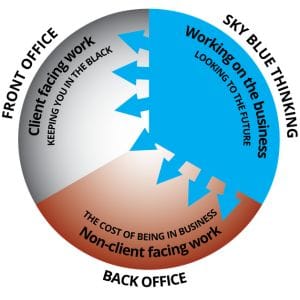 Here’s how it works: over a 2-week period, make a note of exactly what you’re doing and how long you’re spending on each activity. Then for each activity, code it red, black or blue and add up how much time you’re spending on each type of work.
Most accountancy firm owners score terribly on Blue work. They’re spending 80-90% of their time on Red and Black work, with maybe 5% on Blue work – and that 5% only happens when they’re on holiday or in the shower.
Your goal? Ditch, delegate, or do differently Red and Black work to free up at least eight hours a week for Blue strategic growth. Without this protected “headspace,” you cannot design the machine that makes accounting firm growth automatic.
Having headspace is essential if you want to grow a profitable accounting firm. It isn’t about meditation or mindfulness as such. It’s about giving your mind the freedom to think, pause, reflect or go where it needs to go. It means getting your brain away from the day-to-day distractions of life as an accountancy firm owner (emails, calls, discussions with clients or staff) and your responsibilities outside of work (family, bills, cooking, housework, etc).
Giving yourself permission to have headspace is like giving your brain a new office with a whiteboard to design a new practice and plan for its implementation. When you go on holiday, you give yourself precious headspace time. This is why you almost always come back brimming with ideas. It’s also why taking a long shower is a great way to generate ideas.
a
a
Winning business for accounting firms isn’t about big gestures. It’s about regularly turning up and staying front of mind with your existing clients, introducers, and potential clients. And in that order. It’s about doing a little bit of business development each day, regardless of how much work you have at the moment.
We try to really drum into our Accountants’ Growth Club members that “Consistency trumps big, rare gestures.” And to do this, we recommend what we call a Tactical Marketing Plan (i.e. a plan which details exactly what marketing activities will be done when)
Your Tactical Marketing Plan looks at the accounting firm you want to grow and converts that into a specific list of where you’ll get new business, what activities you’ll do to get it, and how much business you’ll get from each type of activity.
We recommend that our Accountants’ Growth Club members create a plan that answers:
Once you have this plan, you can then systemise business development with three simple routines:
 Once you have a clear idea of who you want to get in touch with, it becomes so much easier to hone in on your prospect list. We recommend that our members have something which we call a Stick List. This is a list of every live lead with the immediate next step required to move them forward. Each entry on the list contains:
Stick this list somewhere you’ll see it daily. Then spend 15 minutes reviewing it and taking action on whatever can be done that day to move forward any item on the list. This daily habit keeps your pipeline active without consuming hours of your time (i.e. focused and consistent business development).
Host a weekly team meeting to review “Numbers Which Matter” (KPIs) and progress on quarterly growth tasks.
Your role is to keep the momentum going, even during busy periods, and to monitor the progress of the firm against its growth tasks. That’s why, at Accountants’ Growth Club, we recommend having these Rhythm Meetings. They tick over with regularity and the agendas are basically the same. While the accounting firm is progressing well with its growth actions, and the indicators are green, the meetings are short.
Systemise non-transactional calls to your “A-grade” clients once a quarter to spot upsell opportunities before they become emergencies. These are conversations where your fee earners find out about how the client is doing, what challenges they’re facing and what goals they’ve set.
You’re not calling to chase an invoice or discuss this month’s management accounts. You’re calling to build the relationship and understand what they actually need. This is where advisory work comes from, not from pushing services, but from understanding their business well enough to spot opportunities to help.
a
a
The hardest part of being the boss is that there’s no one to kick you into action. When you’re busy, it’s all too easy to let business development slide because “there’s no one chasing me for it.” To stay on track with how to grow an accounting firm, here are five ways to create accountability.

With the senior people in your practice, create a 3-year Growth Plan. Identify the core themes for the Growth Plan and expand each theme into specific growth actions. Then identify your Numbers Which Matter – the KPIs that tell you whether you’re on track or not.
Identify a One Big Focus for the next quarter. Set up a meeting with all your staff to explain the reasons for this focus. Split your staff into their normal teams to identify growth tasks needed to achieve it.
This quarterly rhythm keeps your team aligned and prevents you from trying to do everything at once. You can’t fix pricing, hire three people, and overhaul your marketing all in the same quarter. But you can make significant progress on one big thing.
Create a Numbers Which Matter Dashboard that the team updates weekly. Use a traffic light system: Green is on track, Amber needs intervention, and Red requires corrective action from the owner.
This visual accountability keeps growth front and centre, even during busy periods. When everyone can see the numbers, they can’t be ignored.
Implement Daily Operational Huddles (10-15 minutes) and Monthly Leadership Reviews (about an hour) to keep the focus on the One Big Focus for the quarter. Here is where you will review progress against the One Big Focus and the firm’s 3-year Growth Plan. These meetings create the drumbeat of accountability that keeps growth moving forward.
Seek a mastermind group or a coach to provide constructive feedback on your growth plan and ensure you don’t revert to old “autopilot” routines when busy.
 Case study: Guy’s mastermind group gave him the headspace to grow
This case study is an extract from the Accountants’ Millionaires’ Club Book. Get your copy for free here (just pay postage and packing)
Guy Robinson, founder of Xebra Accounting, has always considered himself one of the profession’s deep thinkers, but found it difficult to get time to properly think and reflect on a day-to-day basis. There are always so many interruptions, distractions and client work that needs to be done.
While walking his two Saint Bernard dogs every day gives him that much needed bit of sanity and headspace, it wasn’t enough. This is why he asked his co-authors to form a monthly mastermind group with him.
Every quarter he takes a day out of the business to meet with them. They meet the evening before their mastermind day in a location central to them all. Guy finds that relaxing, talking and working with his fellow authors – who he trusts implicitly – inspires him, but gives him that much needed headspace time to truly work on his plans to grow the business.
The day itself is also headspace, involving five heads. Each of them gets constructive feedback on their Growth Plans from the other four members. Almost always one of them has seen another practice already doing these types of improvements, so the sharing of experiences adds real richness to their Growth Plans.
This is exactly what we offer through the Accountants’ Growth Club. Every member gets their own Growth Expert for one-to-one coaching, plus access to mastermind groups with other accountancy firm owners at similar stages. You’re not doing this alone, and you’re getting expert guidance plus peer support from people who truly understand the challenges you’re facing.
a
Documentation removes the cognitive load of “deciding” what to do next. And here’s why this works: your brain can only make a certain number of decisions each day. The more tired you are, the fewer decisions your brain can make.
Because of this, human brains often go into ‘autopilot’ and push you back into your old ways, routines, and habits. That’s why you want your business development activities to become part of your everyday routine.
If you’ve got a plan, you don’t have to consciously think about what business development you’ll work on because it’s already on today’s to-do list. And that is one of the ways you can make your business development so much easier. If diarising and doing a little bit each day is how you work, then this is more likely to happen, however pressing your client workload.
If you want to understand how to grow an accounting firm sustainably, you must standardise three areas:
A standardised list of how many leads you need and which channels (existing clients, social media, referrals) will provide them. This becomes your roadmap that anyone on your team can follow.
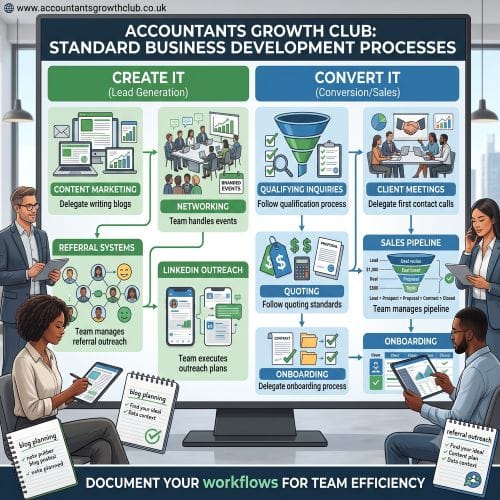
Document your firm’s “Create It” (lead generation) and “Convert It” (sales) workflows.
Create It: Everything your practice does to generate a client lead. This will include all of your lead generation processes – networking, content marketing, referral systems, LinkedIn outreach etc.
Convert It: Everything your practice does to qualify and convert a client lead into paying client work – qualifying enquiries, new client meetings, quoting, managing your sales pipeline, onboarding etc.
When these processes are documented, you can delegate them to your team or external experts. You don’t need to be the one writing every blog post or making every first contact call. Your team can follow the process.
Use simple pricing signposts to act as a filter, qualifying out price-sensitive “tyre kickers” before they ever reach your diary.
Trust us when we say, you don’t need to list every single thing you offer and have a complex price list on your website. (In fact, accountancy owners should really stop doing this!). Think of it as a pricing signpost – a single, simple line on your services page. Something like “our monthly accounting packages for agencies start at £400.” That’s it. This strategy works because of a psychological principle called ‘Choice Overload.’ Research shows that when consumers are faced with too many complex options, they often experience decision paralysis and defer the choice entirely. A single signpost reduces this friction.
If a prospective client is looking to only pay £50 a month, they’ll leave. That’s fine. That filters them out. You don’t need to be appealing to everyone. Just the clients you actually want, and that will be best for your bottom line.
a
Growing your accounting firm shouldn’t mean working yourself into the ground. It shouldn’t mean lurching from “too busy to think” to “panicking about where the next client is coming from.” And it definitely shouldn’t mean waiting until you’re quiet to start thinking about business development.
The good news? It doesn’t have to mean this.
The Work In/Work On Trap isn’t inevitable. The accountancy firm owners who break free don’t work harder, they work systematically. They protect their headspace; they build routines that keep business development moving forward, even during busy periods, they document processes so their team can execute, and they create accountability so they don’t slip back into old habits.
You didn’t start your practice to become the highest-paid technician. You started it to build a business. But building a business requires you to stop being the technician and start being the business owner. That means protecting time to work ON the business, building systems so business development happens whether you’re personally doing it or not, and getting support so you don’t revert to “autopilot” when things get busy.
Our advice for how to grow an accounting firm? Stop waiting for things to calm down. They never will. Start building your business development process instead.
a
 Written by Becky Rogers. Becky has spent the last 10+ years writing copy and content for Accounting firm owners and Accounting specialists. Over the last 5 years she’s written copy for over 30 accountants’ websites. Connect with Becky on LinkedIn.