

The advice given in this article on client onboarding for accountants is drawn directly from our book, Profitable Pricing For Accountants .
To buy your copy of the book directly from Amazon: Click here
To download the first 4 chapters of the book for free: Click here
Onboarding isn’t just a simple process; it’s the key to understanding your clients and meeting their unique needs. If smooth and efficient, your onboarding process should set the foundation for a long-lasting and productive client-accountant relationship.
During the onboarding process, it’s your responsibility to understand what drives your client. Why? Because your value as a trusted advisor is directly linked to your ability to solve their challenges effectively. Don’t hesitate to dig deep and ask meaningful questions about their personal and financial aspirations, going beyond the routine account submissions. Take this opportunity to learn about their concerns and preferred communication style.
If you do this – go above what is expected and make it all about the client – you won’t just onboard successfully, you’ll turn your clients into raving fans, And guess what? Fans tell others.
Here are the five principles that make a good onboarding process:
 1. Personalise the experience
Treat each client as an individual with unique needs and expectations. Tailor your approach to align with their specific requirements.
Keep the client informed of each step and provide updates on progress. It’s also really important to set realistic expectations, so be transparent about what they can expect regarding timelines and deliverables.
The goal with your onboarding process is to foster a collaborative relationship, so encourage open dialogue and mutual respect.
Anticipate potential challenges and have solutions ready. That way, you can proactively address any issues that arise during onboarding.
Educate clients on the accounting systems and processes to foster self-sufficiency and understanding, which increases engagement.
Maintain adherence to all regulatory requirements, such as Anti-Money Laundering (AML) checks, to build trust with the client.
Standardising your practice’s way of working enables you and your team to be hyper-efficient, consistently use best practice, and minimise the risk of missing client deadlines or making mistakes. In short, a clear onboarding process aligns the firm, the client, and the team, ensuring the best possible experience from the very beginning.
Yes, standardising your ways of working is a major undertaking, but as the saying goes, “How do you eat an elephant? One bite at a time!”
Onboarding is part of the firm’s “Convert It” process, covering everything you do to turn a lead into a paying client. This means that your onboarding process high-level workflow must cover:
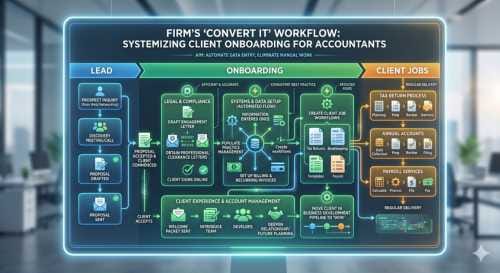
As you can see, the onboarding process is traditionally manual but it is ripe for automating! The aim with automation is to eliminate manual data entry by your staff or the client as much as possible; information should only be entered once.
As already stated, getting your clients onboarded is a time-consuming process involving lots of manual data entry on many different systems. This process easily falls down if not tightly managed. Here are three tools which will help you automate the majority of the onboarding tasks:
This is a great new piece of software that has set up as a deliberate alternative to GoProposal and Ignition. It takes the best bits of both software and puts it into a brilliant (in our opinion) pipeline, pricing, proposal and client onboarding software. It’s founded by Jonathan Gaunt the former founder of Xavier Analytics which was bought by Dext and became Dext Precision. If you don’t want to opt for an all in one type practice management solution such as Engager then Socket would be our recommendation. (And we are not paid to say this!)
Socket describes itself as:
Socket is a suite of tools for accountants and bookkeepers to level-up their client engagement, prevent scope creep, and protect their profitability by pricing with clarity.
It does many things. But when your client has given you a verbal ‘yes’ it:
 Our founding member of the club, Jessica Pillow, founder of Pillow May Accountants, uses Socket. She found that using it helped them as a firm:
Engager is an all in one practice management software. It is one of the most popular pieces of practice management software used by accountants’ growth club members. Like Socket it:
The beauty of Engager is it has a great price point AND has been bought by TaxCalc. Which means when it is fully integrated you can run your whole accounting software suite within Engager and TaxCalc.
This is a piece of software that makes it easy to get information out of clients. Whilst it doesn’t do pricing or proposals, what it does do is make the information gathering stage of onboarding much smoother and slicker.
The best way to describe Content Snare is that it is a secure client portal for accounting firms and bookkeepers. It handles the part of your workflow that practice management tools don’t do well: getting clients to send you their tax return documents, onboarding paperwork, and compliance records.
Instead of chasing clients by email, you give them a secure portal where they upload what you need, answer your questions, and complete tasks on their own time.
Automatic reminders do the follow-up for you.
Ignition automates the process when the client signs the online proposal document. Upon signing, the following steps happen automatically:
The real value of Ignition is in its integration with Zapier, which allows triggering workflows across various systems (e.g. adding clients to the email list or setting up Karbon workflows, for example).
 Case study: Guy doubled his practice efficiency through systemisation
Guy Robinson’s practice, Xebra Accounting, was growing by 40% each year, taking him from £200k to £400k turnover in just 2 years. But with so many new people joining the team, his efficiency dropped off a cliff. His practice efficiency was running at £20/hour.
Guy used his coach at the Accountants’ Growth Club to keep him accountable to standardising each workflow. He categorised services into Bookkeeping, Accounts and Advisory, then worked with his team in weekly meetings to identify the most effective way of doing each activity. They produced checklists for every activity.
The result? By standardising their practice’s way of working and managing individual performance consistently, they nearly doubled their practice efficiency from £20/hour to £37/hour.
Case study: Paul systemised to reduce staff costs from 43% to 35%
Paul loved winning work and being with clients; reviewing accounts wasn’t his idea of fun. He’d optimised his processes for winning work, but his operations needed attention. His staff costs had escalated to 43% of annual turnover.
Paul decided to outsource the standardisation work. His operations manager spent a couple of days with Inform Accounting to see how they’d standardised their processes, then brought in an expert to work with their team. Within three months, Paul had finally done what he’d avoided for decades: standardised how they delivered ongoing client work.
You can not fully automate the onboarding process because humans are involved. For example, we don’t always see automatically produced emails, or we may forget to fill in our new starter form, and it goes to the bottom of our inbox. Therefore, when it comes to client onboarding for accountants, best practice is a balance between automation and the human touch.
Here’s how to get the human touch bit right.
In small accountancy firms, this person may be the Operations Manager, the Client Manager, or the firm owner. It is their role to allocate the Client Manager for the client as well as update the team on the new client win.
They act as the new client’s account manager. Their role is to have the onboarding meetings with the client and create a strong client relationship from the very beginning. They are responsible for setting client expectations at the start of the relationship.
Their role is to follow up with the client for any missing data (e.g. HMRC authorisation codes and ID for money-laundering checks). They also get the new client set up properly on the firm’s systems.
In many accounting firms, this person will also be the Client Manager. After the new client is won, their responsibilities are to make sure the firm’s marketing and sales systems are updated accordingly (i.e. changing the pipeline status to “won”). It is their role to also personally thank the referrer for the work.
The systems onboarding is a key part of the onboarding process as a whole because this is where you set expectations on how the firm will work with the client and train them on the firm’s preferred systems (e.g. cloud accounting software, Content Snare, Client portal etc).
Set up the client in the accounting software and other relevant systems (e.g., Karbon, Xero, Engager). This may also include setting up the client on monthly billing via Direct Debit. You then need to provide them with the necessary training to use the systems effectively.
Once the systems are in place, conduct a final review meeting with the client. Present the accounting plan, including milestones, timelines, and responsibilities. Address any outstanding questions or concerns and seek client approval. Encourage feedback from the client about their onboarding experience.
Unless your accounting firm is just you, other members of your team will be working with this client at various points. This means you need a systemised way of updating your team about the new client. It’s not just what the client is doing right now and the services they are taking from the team. It’s the detail and colour about the client, including the aspirational stuff. Things like they have three other companies (and we want to get them too), or they are really worried about timeliness as they had to pay fines to HMRC last year.
There’s nothing worse than getting a great client through the door, just for a team member to muck it up because they hadn’t been told something really important about the client. So make sure that all notes, details and aspirational information about the new client are accessible and communicated to the whole team. For example, we recommend sharing this information in weekly Rhythm Meetings to our Accountants’ Growth Club members.
Case study: Sian implemented performance reviews to retain her young team
 When Sian Kelly, founder of Inform Accounting, worked in industry, bi-annual performance reviews and monthly performance conversations with staff were just something she did. After setting up her own practice she stopped; she had got lazy.
Her practice had grown, and over 18 months she’d recruited 4 trainees (a mixture of school leavers and graduates). They were bright, intelligent and super keen to progress. Sian rapidly realised that if she was to achieve her 3-year Growth Plan and retain these young staff members, she needed to standardise how she supported their development.
She put together a competency framework showing staff what attitudes, behaviours or skills they’d need as they progressed. She created job descriptions for all roles. She implemented mini 3-month performance reviews focusing on identifying gaps in knowledge and skills.
After the first round of performance reviews, Sian was kicking herself for not starting them much earlier. Her staff really appreciated the focused time. Since implementing regular performance reviews and monthly performance conversations, no staff member has left her firm.
Remember all those promises you and your firm made to your clients in those new business meetings before they came on board? You know the ones:
We’re proactive
We give you a personal service
We are accessible and responsive.
You need to make sure that in the first few months of your working relationship, your firm really delivers on these promises (and then carries on delivering!). This is a minimum. Onboarding new clients is so much more than just getting them set up on your systems and ticking the regulatory boxes, you need to make the client feel valued and special.
Word-of-mouth business is often the cheapest type of new business to generate, but the hardest to reliably generate. Bain and Company discovered that 60–80% of clients who describe themselves as satisfied don’t go back to do more business with the company which initially satisfied them. Gone are the days where clients would routinely recommend your accountancy firm to others just because your firm did a good job. Doing a good job is what’s expected, not what will get you client referrals and word-of-mouth business.
In order to reliably generate word-of-mouth business and reduce client churn, your firm needs to routinely deliver extraordinary client service. This means not just doing a great job with a client but going the extra mile. This extra mile is normally something that’s unexpected, personalised to the client and typically very cheap or free to provide.
For instance, here are simple ways to make your clients feel valued:
 Send a handwritten card or a short personalised video clip thanking them for signing up. You could also provide a welcome pack containing contact details, a rate card for ad hoc work, and a list of agreed services. Other personal touches include:
Acknowledge and celebrate important milestones during the onboarding process to make clients feel valued.
The Client Manager should connect with the client on social media and schedule initial check-in calls (e.g., Month 1, Month 2) to check on progress.
In order to identify pain points that clients are motivated to solve, your firm will need to systemise non-transactional type conversations with clients. That is, conversations which don’t focus solely on the current work at hand. This is often called account management. Schedule regular non-transactional conversations quarterly, especially for high-value clients, to identify future opportunities and prevent churn.
If you want clients to buy additional advisory services, the firm needs to create an exciting picture of how it can help the client improve, outlining the Return on Investment (ROI). This includes the 3-month meeting, which is the ideal time to potentially re-quote if required, make suggestions for improvement, and see whether they need extra services.
Extra tip? Firms must also reduce client churn by measuring client losses, conducting exit interviews to find the real reasons for departure, and systemising processes to correct identified problems.
If you regularly meet clients in the office, there are a few easy things you can do to exceed their expectations. For instance:
 Case study: Paul’s welcome process for new clients
Paul Miller‘s firm, Cornish Accounting Solutions, spends significant time qualifying new clients to make sure they’re a good fit. Given the time spent in qualifying, when they do win a new client they really want to roll out the red carpet.
Each new client gets:
Given the time and effort it took to win your new client, the last thing you want is to create a bad first impression that persists throughout your entire working relationship. After all, this is the time when the client is most unsure about your firm. Instead, use standardised workflows and systems so that you can deliver consistently high-quality work.
Remember, your onboarding process isn’t just ticking boxes; it’s the foundation for every referral, every upsell, and every long-term relationship. So the question isn’t whether you can afford to invest time in proper onboarding, but rather, can you afford to keep losing clients in the first 90 days because you didn’t?
 Written by Becky Rogers. Becky has spent the last 10+ years writing copy and content for Accounting firm owners and Accounting specialists. Over the last 5 years she’s written copy for over 30 accountants’ websites. Connect with Becky on LinkedIn.