
Written by Becky Rogers, copy and content writer for Accounting firm owners and Accounting specialists.
Your website says you’re “proactive accountants who help small businesses grow.” You promise to “speak their language” and “save them tax.” You’re “not your average accountant.” Sound familiar? That’s because every other accounting firm is saying the same thing. When prospects can’t see a difference in value between you and your competitors, they default to comparing on price. The result? You attract price-sensitive leads, tyre kickers, and clients who shop around, and your conversion rate is far from where you want it to be.
We see this all the time with new members of the Accountants’ Growth Club. They’re terrified of niching because they think they’re losing potential work, but not doing so is causing more harm than good. When working with us, they soon see that focusing on a niche and being specific with their website means they “lose” the work they don’t want and start winning the work they do.
If you want your website to qualify your leads for you so you can spend your time having decent conversations with prospects who you know are already a good fit, then you need to speak directly to them and tell them why they should come to you over someone else who does the exact same thing. Here’s how to differentiate your accounting firm so you attract the right people who are happy to pay your fees.
Phrases that accountants view as values are often seen by clients as “table stakes” or generic buzzwords that fail to create an emotional connection.
 Messages like “We speak your language,” “Not your average accountant,” “We are proactive,” “We save you tax,” or “We help you grow your business” have become so common that they’re now ignored by high-value prospects. Why? Because they’re generic, they don’t mean anything, and they don’t convey value or elicit any sort of emotion that will start a conversation.
When you tell prospects, “We’ll help you save tax,” they think, “Well, surely that’s table stakes for a good accountant.” When you say “We’re approachable and friendly,” they think, “Isn’t every accountant supposed to be approachable?”
When clients cannot see a direct difference in value between two firms, they default to comparing them on cost. Not surprising, really. When the only thing we’re giving people to compare on is price, we’re training them to ask about price because they’re not building that emotional connection. In short, it’s a race to the bottom.
If you told a prospect:
“We’re proactive accountants who help SMEs.”
OR
“We help service businesses in the Northwest that make and move stuff double their profit and work three days a week.”
Which one would make you lean in and want to know more?
a
Most clients can’t differentiate one small accountancy firm from another. In their eyes, one set of accounts looks pretty similar to another set of accounts. (And have you ever had a client compliment you on a ‘beautiful set of accounts’?) When they can’t tell the difference, they buy on price. It’s that simple.
So if you want to win bigger, better clients who don’t haggle, you need to differentiate. Here are the three ways to do it (without losing that broader market appeal if that’s what you’re worried about).
This is the number one way to differentiate your accounting firm, and we shout this from the rooftops with all our Accountants’ Growth Club members. Yes, you need to get really specific with who you’re targeting.
To this day, we’re still trying to convince some members of this fact. Why? Because like many accountants, they worry that if they start marketing to a niche:
These worries make sense on the surface. But here’s the rationale behind committing to a niche, so the logical part of your brain can shout louder than your amygdala (that pesky part that is responsible for fear).
aYour firm’s marketing isn’t aimed at your existing clients. It’s aimed at the new ones you want to win. If you deliver great service, your current clients couldn’t care less about your niche. That’s the difference between marketing and delivery.
Actually, the opposite happens. By focusing on a niche, you’ll attract the right sort of clients – the ones you really want to work with and find rewarding (in more than just the fiscal sense). You don’t have to turn clients away outside your niche if you don’t want to. You just don’t market to them.
This is what is known as “The Paradox of Choice”, a term popularised by psychologist Barry Schwartz, and in a nutshell, it means that giving your prospects too much choice causes analysis paralysis. Whereas, narrowing your focus often leads to more leads and higher conversion rates because you become the obvious choice for a specific group.
Beyond winning the right type of clients, here’s what else happens when you commit to a niche:
By intentionally repelling low-value “legacy clients,” you create the headspace needed to focus on “golden egg” clients who pay premium fees.
Case study: Phil’s niche generated 90% conversion rates
Phil is an accountant who specialises in independent retailers. Over the last few years, he’s built strong relationships with several other retail specialists, including a lawyer and retail branding expert. Two-thirds of his referrals each month come from these retail specialists, and these referrals convert 90% of the time.
We ran a webinar on “Effortless ways to win £3k+ clients” and did a live poll asking attendees if they have a niche. The results?
While our poll found that only 10% of firms have a definitive niche, we’ve actually observed something different. At the Accountants’ Growth Club, we’ve found that most people have a niche but don’t realise it. And even if they know they have it, they don’t know how to market it properly.
An important thing to remember is: you don’t always need a single industry sector to have a niche. You can focus on life stages, technical specialisms, or specific mindsets. Here are two ways to find or choose your niche:
1) Identify clusters from your existing client base
 Use a Client Portfolio Analysis to find groups of similar clients you already enjoy working with and who provide the highest reward.
Search for the golden goose that lays the golden eggs, so to speak, and find the value in your current client base. Not all clients are created equal; however, there’s a spectrum:
a
2) Identify a niche that you would like to work with
Your firm doesn’t have a niche if it specialises in “entrepreneurs,” “small businesses,” “SMEs,” or “owner-managed businesses.” These are poor niches because they’re too broad. An entrepreneur could be Richard Branson or someone with a jam-making business who sells a few jars to friends every month. It’s not specific enough.
“Creative agencies with lumpy cash flow” is a tight, marketable niche. “Growing service businesses in the Northwest” is specific. “Contractors preparing for exit” works.
The 4-Test Framework: Evaluate a potential niche based on your Passion, Credibility, Fit, and the Market Size.
Go back to your Client Portfolio Analysis results and look for clusters of similar types of clients. Then use these clusters as your shortlist of potential niches to adopt. With these candidates in mind, ask yourself:
A good choice for a niche will satisfy all four conditions:
If you’re struggling to decide on one or two niches to focus on, try plotting a graph with the axes Reward versus Passion. Then plot your candidates onto the graph. The best candidates will be where your passion and the reward level are both high.
 Case study: Paul focused on businesses that “make and move stuff”
This case study is an extract from the Accountants’ Millionaires’ Club Book. Get your copy for free here (just pay postage and packing)
Paul Wareham, founder of PSAccountants, initially resisted niching, insisting he didn’t need “this niche thing.” After struggling to win the right type of business for months, he agreed to try.
Through a client portfolio analysis, he discovered what he really loved was working with businesses in the Northwest that make and move stuff. So we worked with him to rewrite his QuickBooks advisor directory entry and his LinkedIn profile to focus on this niche.
Within four weeks, Paul had two people who’d seen him on the QuickBooks ProAdvisor Directory, checked him out on LinkedIn, rang him up, and signed up on the phone with no quibble, taking his top package. Paul said, “This stuff works. I’m going all in.”
a
a
Generic language won’t cut it if you want to win the right type of clients. You need to create an emotional connection with your audience.
Why? Because the initial impulse to hire an accounting firm is almost always emotional, backed up by rational logic later. This is where pain points and desires come in.
Your clients will be driven to buy your services by a pain point: a deep-seated emotional rather than logical reason. Why? Because the initial impulse to hire your accounting firm is always emotional, then backed up by logical and rational reasons to buy.
Your client persona research will have helped you identify these pain points, which will be the underlying reason why your niche market wants to buy your services. So these pain points will form the basis of the services you offer.
It’s tempting to think you already know the pain points for your clients. After all, don’t most clients want to save tax and grow their business? Or work less and still enjoy a decent income? While that answer is most likely yes, if your research hasn’t gone deeper than this, it’s time to go back and do more research.
For example, a business owner is unlikely to buy more advisory services from an accountant because they want to “grow their business.” The real reason is more emotional, such as “I want to double the income I can take out from my business so I can send my children to private school.”
Once you know their real pain points, you should then use your copy to address deep-seated challenges, such as a business owner feeling overwhelmed or out of control.
 Shift your messaging from what you do (accounting) to the transformed state the client craves (freedom, cash, or control).
For example, your lead is currently in the “as-is” state: they’re stressed, overwhelmed, and working 60-hour weeks. Your questioning needs to establish the “to-be” state. What are their goals and aspirations? What’s really important for them to achieve and why?
Once you’ve helped them identify their to-be state, the next part is to increase the distance between their as-is state and the to-be state. After all, if it were easy to get there, they wouldn’t need your services.
Good questions to use:
Your website heading should communicate the to-be state, so start with that when you update your website. Keep it simple and get specific. Change it from what you do to who you actually help and the specific outcome you provide.
Instead of saying “We provide accounting services for SMEs in the Northwest,” try something like “Stress-free financials for creative agencies so they can focus on their client work.”
In one sentence, it immediately repels anyone who isn’t a creative agency and attracts those who are. The prospective client can begin to differentiate between you and someone else, and they’re not just thinking about price at that point.
E-E-A-T stands for Experience, Expertise, Authoritativeness, and Trustworthiness, and this is essential for being found online today. To demonstrate these to Google, you need to include hyper-specific case studies and testimonials in your online marketing that resonate with your persona. This is more important than ever for AI search as well.
For example, a testimonial from a construction firm owner (if you’re a construction specialist) about how you help them manage project profitability will resonate deeply with others in the trade and mean nothing to a dentist. Which is precisely what you want. This will also signal to Google and AI search engines that you are an expert rather than a generalist.
When you start doing the client persona work and thinking about who you’re actually speaking to, your copy should become your gatekeeper. A “who we work with” section is brilliant for this. Be explicit. Say “we’re the perfect fit for you if…” and list three or four characteristics of the ideal client.
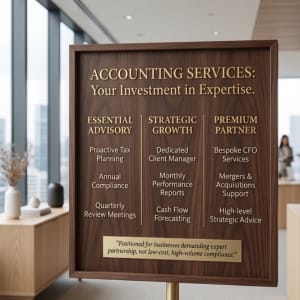 At the beginning of this article we said the goal of your website is to have it do the qualification for you, and it should. Your website is there to be a tool, not just so you can tick a box saying “I’ve got a website.” It’s got to earn its keep.
To make it earn its keep, you have to display prices.
We know what you’re thinking – we’ve heard it all from our Accountants’ Growth Club members – but this is non-negotiable. You don’t need to list every single thing you offer with a complex price list. You just need a pricing signpost.
A simple line like “Our packages start from £400” immediately repels price-sensitive “tyre kickers” who only want to pay £50.
Why is this so important? For three reasons:
Dr Robert Cialdini conducted research on analysis paralysis and human behaviour regarding spending. He discovered that people are more likely to take action when minimal parameters are set. For you, this means the following:
If you haven’t primed a potential fee level with a prospect before you speak to them, they’ll walk into the sales meeting with their own number in mind. This is the budget they’ve mentally allocated (an “anchor”), so if your proposed fee is much higher than this number, you’re unlikely to win their business.
By mentioning your minimum fee first, you’re anchoring this number instead. Meaning, there’s no room for negotiation because you’ve primed them before you even meet.
aYour website should act as a gatekeeper, qualifying leads via price and persona so you can focus on high-value sales meetings. If someone’s on the website looking to pay only £50 a month, they’re going to leave. That’s fine. That filters them out.
Remember, you don’t need to appeal to everyone. Just the clients you actually want and that are going to be best for your bottom line.
a
Does your website pass the commodity test? A few quick tests to check are:
The “Logo-Swap” Test: If you removed your logo and firm name from your homepage, would a prospect still be able to distinguish you from 10 other local competitors?
The Generic Test: If your website copy focuses solely on being “proactive” or “saving tax,” you’re training clients to compare you based on price alone.
The Digital First Impression Test: According to Hinge research, over 80% of prospects will check your website before contacting you. If it feels like an outdated brochure, you’re losing high-quality leads before they even reach out.
The state of your website is a strong indicator of the type of clients you attract. If it screams low prices, it’s going to attract price-sensitive clients.
When prospects land on your site, what’s the first thing they’re looking for? If you’re targeting high-value clients, they want to know they can ethically save on taxes, get more of their time back, and grow in their niche or prepare for an exit.
Your website needs a clear path set out that speaks directly to these desires.
a
Even if your work comes via word of mouth, your prospects will still check you out online. Fail to get the right messages across, and good prospects will slip through your hands.
Worse still, carry on with bland messaging, and you’ll encourage price-sensitive shoppers because the only thing to differentiate on is price.
If it hasn’t been made clear already, your website has to be different from your competitors. You need to be speaking to the clients you want to win (so don’t let your current client portfolio hold you back). Make sure your website speaks directly to them, their pains and desires.
Your website copy needs to:
When your website conveys the right messages (i.e., this is who we work with, this is who we don’t work with), you’ll get a higher-quality, pre-qualified set of leads. Then, if you’ve got the right level of activity and the messaging right, the sales are easy.
The main takeaway? Stop waiting for prospects to “just get it” and start making it impossible for them to miss why you’re the obvious choice.
a
 Written by Becky Rogers. Becky has spent the last 10+ years writing copy and content for Accounting firm owners and Accounting specialists. Over the last 5 years she’s written copy for over 30 accountants’ websites. Connect with Becky on LinkedIn.