Need your team to

STEP UP

Find out everything you need to know about leading and managing people in this hub.

If you are going to grow and scale your practice beyond you, then you will need to be able to lead and manage people.

This is why two of the 6 profit pillars we check in our free Growth Assessment are Pillar 3 – Team Performance – and Pillar 5 – Owner Time & Role Clarity. 

How to get your team to drive the growth of your practice

Written by Becky Rogers, copy and content writer for Accounting firm owners and Accounting specialists.

You spent most of a weekend mapping out the next three years. You ran the numbers, set your KPIs, and built a punchy but achievable forecast for your business. Then you sat your team down to go through it. Funnily enough they didn’t seem to be that excited about it. After all, they had been here many times before and knew that after a flurry of initial excitement it would go back to “business as usual”. And yes, 2 months later it was still the ‘same old, same old’.

This actually happened to one of our Accountants Growth Club members. The key question is how to get your accounting team to drive the growth of your practice. Not just do the day to day client work, but be equal partners with you to grow and scale your accounting business.

According to Gallup research, fewer than one in three employees feel strongly connected to their company’s mission. Furthermore, managers account for roughly 70% of the variance in team engagement. This means that you are the biggest influence on whether your accounting team buy into your hopes and dreams for your practice. Get it right and they come with you. Get it wrong and it will be ‘the same-old, same-old’.

Here’s how to get genuine employee buy-in for your plans to grow your accounting business, so your team takes responsibility for growing your accounting business alongside you. After all, wouldn’t it be much easier to grow and scale your accounting practice if your team were taking some or all of the heavy lifting?


Key takeaway:

  • A bought-in team takes active responsibility for driving practice growth rather than just doing basic day-to-day work.
  • Align staff by involving them in planning early and showing how their daily roles support the overall vision.
  • Break long-term plans into simple, visual targets with single quarterly themes (“One Big Focus”).
  • Keep growth top-of-mind using brief daily huddles, weekly meetings, and quarterly reviews.

Compliance vs commitment

There is a massive difference between a team that goes through the motions and a team that is fully committed to helping you grow and scale your accounting business.
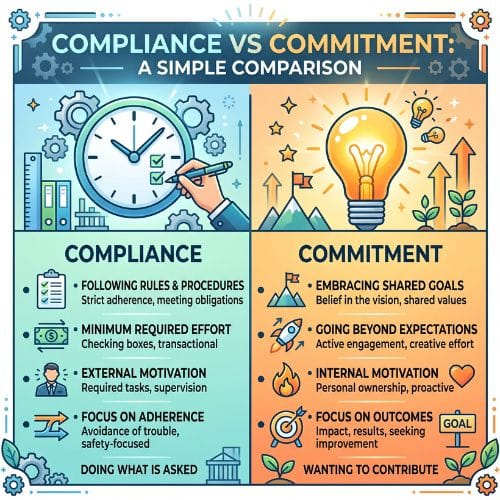
Infographic comparing compliance (rules, minimal effort, external motivation) versus commitment (shared goals, exceeding expectations, internal motivation) using icons like a stopwatch for compliance and a lightbulb for commitment and employee buy in.Compliance is what happens when people do what they are told simply because you pay their wages. You can expect them to do their day job. But doing stuff like “taking initiative” and “driving the growth of the business”, unless its in their job description and you keep them honest to this, just won’t happen. If you challenge them why they are not doing this, then you are likely to be told “nobody told me,” or a “that’s not my job” or “I didn’t realise I needed to do this”.  

When employees are fully committed and bought in to your growth plans, it will feel very different. They will understand and be excited about where the firm is heading. Alongside this, they believe your goals to grow your accounting firm are achievable and want to be part of that growth.

The 3-Week Test: If you stepped away from the practice for three weeks, would anything on your 90-day growth plan or 3-year growth plan move forward? If the honest answer is no, you have compliance, not employee buy-in.

4 ways employee buy-in supports the growth of your accounting firm

An engaged team changes what your practice can achieve in four ways:

  1. They handle change smoothly: Whether you introduce new software, change onboarding procedures, or outsource workflow, a bought-in team adapts quickly. Of course, there may be some initial, but healthy resistance. But in the main, any change goes relatively smoothly.
  2. Their daily focus improves: Staff members prioritise their workload to ensure the day to day client work gets done alongside any tasks from your accounting firm’s 3-year growth plan rather than doing what they have always done.
  3. They stay with your firm: Staff who get your firm’s ‘why’ and feel connected to the vision for your accounting firm are unlikely to leave for a slight pay rise.
  4. They solve problems early: Employees raise issues early and fix them independently before minor glitches turn into crises that only you can manage.

Read how club member Rachel Sestini got her team to come on board with her growth plan. This was a key factor in her successfully exiting and selling her tax specialist practice to Shaw Gibbs.

How to disengage your team

No accounting firm owner deliberately decides to annoy their team. After all, that would be commercial suicide/ Instead, this disconnect or disengagement often happens through routine decisions:

  • Keeping your accounting firm’s growth vision in your head or only shared at partner/director level.
  • Making major decisions about your firm or how to run it behind closed doors and announcing them to your accounting firm’s team as done deals.
  • Telling people what to do without explaining why it matters.
  • Rarely recognising or appreciating the effort your accounting team is putting in.
  • Ignoring poor behaviours from team members that go against your accounting firm’s values.
  • Having a reward system that rewards behaviours or actions that are working against your accounting firm’s 3-year growth plan.

For example, if you ask for teamwork but only reward individual billable hours, staff will focus on individual billing. What you reward is a far more powerful motivator than what you say.

Is your team aligned? Team Capability and Growth Planning are two core pillars measured in our free Growth Assessment. It takes under 15 minutes and highlights where your firm is leaking momentum. 

Relevant articles

Barriers to growing your firm

If you want to really grow your business, you need to stop firefighting and start working on the business rather than in it. And to be able to do this, you need an effective team behind you. This is why two of the 6 profit pillars we check in our free Growth Assessment are Pillar 3 – Team Performance – and Pillar 5 – Owner Time & Role Clarity. 

To see whether you have a role or team performance issue or a bigger, more systematic problem, take our 10-15 min free Growth Assessment here.

Helpful resources

Get back in control of workflow by getting team members to fill in this free (unbranded) end of week report. Click here.

Not sure how to fix your team to get it to work together better? Download our team effectiveness review to pinpoint exactly what you need to do to fix it. Click here. 

Download our low-confrontational way of dealing with low performers masterclass recording. Click here.

Find an extra 8 hours to work on growing your firm. Our webinar will help you minimise interruptions and the demands on you from your staff and clients. Click here to download our webinar recording (for free)

Want to go deeper?

Get a free copy of The Accountants’ Millionaires’ Club book (you just pay for postage and packaging). 

Chapter 1 shows you how to eliminate work from your desk, freeing up an extra eight hours a week for essential strategic thinking time and headspace. (Read this if you find yourself firefighting most of the time and working very long hours)

Chapter 4 will help you if your practice is constantly running over capacity with a perpetual backlog of client work.

Chapter 6 & 7 cover how to build the right team around you and how to lead and manage your people.

Order your free copy here.

a


An older man with short grey hair and glasses smiles warmly. He is wearing a checked shirt with red, blue, and white stripes, standing indoors in front of a window with white frames.Case study:How Guy lost his Number 2 by keeping the plan in his own head

Guy Robinson, owner of Xebra Accounting, returned from a peer mastermind group excited about a practical, low-risk plan for his practice, and he couldn’t wait to take his team through it.. The next morning, he did exactly that, and assumed the meeting went well.

Then, his number two, the person he delegated to most, the one holding the practice together, resigned to join a local competitor.

When Guy asked what he could have done differently, her answer was eye-opening. She explained that the growth plans sounded risky to her. She needed to see how the firm planned to reach those targets and how other practices had done it successfully.

This was painful to hear because Guy had all of that background information. He’d done the work, but he had kept it to himself. As a result, poor communication cost him his best team member.

Today, this experience has permanently changed how he leads: he now spends far more time talking to his staff about the growth vision and the plan behind it, rather than assuming that presenting the conclusion once is the same as bringing people with him.


How to build real employee buy-in step-by-step

1. Share the “why”, not just the “what”

The more you tell people about the ‘why’ behind what you are asking them to do, the greater the chance that they will be more engaged with your accounting firm’s growth plans. In an accounting firm, this means linking daily tasks directly to the bigger picture. For example,:

  • The Receptionist: A warm tone on the phone creates the first impression that helps convert prospective clients.
  • The Trainee: Returning an accurate tax calculation promptly gives clients the confidence to recommend our accounting firm.

When presenting your accounting firm’s vision, don’t stop at the top level objectives such as “double the size of our firm in the next 3 years”. Translate this into the day-to-day actions your team members will be doing.

For example: “When our firm has doubled in size, we will be able to afford a dedicated admin person who will be responsible for working with clients to get all the information in. You will then be freed up to spend more time talking with clients about how things are going”

2. Involve your team before decisions are finalised

When staff receive your finalised 3-year accounting firm growth plan without being consulted on it, they will naturally push back.

Six people collaborate in a modern office; one woman points to colourful sticky notes on a board, whilst others sit at a table with laptops and documents, discussing and taking notes. This represents employee buy inWhy? Because no one likes things being ‘done to them’. If you want your employees to buy into your accounting firm’s vision, then they need to feel like they have had a say in the vision.

Consider these two different approaches:

  • The directive approach: Two firm owners presented a plan to reach a £1m practice turnover. However, the presentation focused heavily on their personal goals, such as buying sports cars and moving to bigger houses. Neither staff nor clients found that inspiring.
  • The collaborative approach: The accounting firm owners held interactive workshops where staff mapped workflows, highlighted inefficiencies, and helped set quarterly targets. Not surprisingly, staff were very inspired and much more willing to embrace the resulting changes.

3. Acknowledge the emotional cycle of change

Growth requires people to do things differently. Their responsibilities may change. Or how they carry out their responsibilities may change. Either way, it means feeling uncomfortable about how things are done.

Your team have ways of working they’ve refined over years. They know where they sit, what they’re good at, and how their day goes. Your accounting firm’s growth vision challenges all of that, and accountants in particular take a lot of comfort from the status quo.

Most team members will move through predictable stages during major transitions. Stages which Elisabeth Kübler-Ross identified as the Emotional Cycle of Change:

  1. Denial: “We tried something similar a few years ago.”
  2. Anger: Frustration and pushback directed at leadership.
  3. Rationalisation: “Can we test this on just one service line first?”
  4. Acceptance: The updated workflow becomes the standard routine.
  5. Advance: Staff begin finding their own improvements to the process.

You cannot skip these stages, so embrace them and help your team work through them. This means: Identify what individual team members fear losing (such as direct control over specific client relationships). Then validate those concerns before expecting your team members to be enthusiastic about the change you are proposing.

4. Use storytelling when data isn’t working 

There comes a point where you realise that all your well-reasoned arguments aren’t landing. You’ve explained the numbers, you’ve made the case, and a core group of people are still entirely unmoved.

An open book emits colourful streams depicting teamwork, growth, success, a rocket, graphs, and people, symbolising innovation and business storytelling, on a desk with plants and cityscape in the background.More logic or data won’t fix this. In fact, heavy persuasion can cause defensive teams to push back harder.

What does work is a story. Instead, use stories. Illustrate how a similar accounting practice made a similar transition, overcame obstacles, and created better working conditions for their accounting firm’s team. A well-told story gets even the most cynical accountant to put the critic down for a few minutes, because people get involved in a story rather than evaluating it. Not only that, but it helps team members to visualise success far better than a complex spreadsheet.

Building a 3-year growth plan for an accounting firm that staff can see themselves in

A vague vision produces vague commitment. If you want real employee buy-in, your people need something concrete enough to picture.

Ten-year plans are often too distant, while a one-year plan or a 90-day growth plan may not see the bigger picture. So that’s where the three-year plan for an accounting firm comes in, as it provides a timeframe everyone can imagine and measure. (Want to know how to create a 3-year growth plan? Download our virtual masterclass (for free) here).

An effective accounting firm growth vision must be:

  • Clear: Specific enough that you could capture the outcome in a picture.
  • Visual: Displayed visibly around the office or digital workspace, not hidden in a folder.
  • Positive: Focused on positive achievements rather than avoiding negatives.
  • Simple: Easy enough for staff to explain to someone over dinner.

A whiteboard titled 3-Year Growth Plan is divided into columns for each year and rows for each quarter, outlining tasks and milestones with colour-coded sticky notes for planning business growth.Then break it down so it becomes something people can act on:

  • Focus themes: Select key operational areas, such as workflow efficiency, client development, or staff retention.
  • Key indicators: Select essential metrics to track. Use visual dashboards: green for on-track, amber for minor adjustments, and red for leadership intervention needed.
  • One core focus: Focus on one central theme per quarter to prevent initiative overload. We call this a ONE BIG FOCUS.
  • Co-created tasks: Allow staff members to select and manage their contributions toward the ONE BIG FOCUS.

Not everyone in your current team will want the firm to grow, and that’s to be expected, particularly among longer-serving staff. What you will find is staff members who are not bought into your vision for your accounting firm are likely to vote with their feet. That isn’t necessarily a bad thing. You may want them to leave!

Need help building your strategy? Members of The Accountants’ Growth Club work directly with a Growth Expert to establish clear 3-year visions, quarterly themes, and visual dashboards. Every 90 days, members reset their focus to keep their practices moving forward. 

 a

Keep your accounting firm’s vision alive with structured meetings

An accounting firm’s growth plan that gets presented once is quickly forgotten. What keeps it alive is a rhythm of short, regular touchpoints. We call these Rhythm Meetings because they happen regularly and the agendas barely change; they keep the focus on both the ‘day to day’ and also the unexpected and the growth plans for your accounting firm.

  • Daily huddles (10 mins): Quick stand-up sessions to discuss immediate priorities and remove bottlenecks.
  • Weekly team meetings (1 hour): Focus on current task progress, workflow capacity, and practical challenges.
  • Monthly & quarterly reviews: Review key metrics, celebrate achievements, and set the ONE BIG FOCUS for the next 90 days.

aa

Frequently Asked Questions (FAQs)

How do I present a 3-year growth plan to my accounting team without overwhelming them?

Focus on the immediate “why” rather than handing down a massive list of tasks. When presenting your vision, break the 3-year plan into single quarterly themes and explain specifically how daily roles will stay manageable. Avoid pitching firm targets purely around partner profits, and instead highlight how growth improves team capacity, tools, and career opportunities.

Build buy-in early by involving your team in workflow design before making final purchasing decisions. Resistance usually stems from fear of lost routines or frustration with fait accompli mandates. So, to prevent this, establish regular, short meeting rhythms to gather feedback, acknowledge the friction of learning new systems, and allow staff to co-create their own implementation tasks.

You do not need to share confidential partner drawings, profit margins, or equity numbers to align your team. Instead, share non-confidential operational metrics (often called “Numbers Which Matter”) such as client turnaround times, capacity levels, and target service growth. This gives your staff clear visibility into firm progress without compromising partner privacy.

Staff resistance rarely comes from laziness; it stems from a desire to protect established routines that feel safe and efficient. When a growth plan shifts how work gets done, team members naturally go through stages of denial or anxiety. Firm owners can overcome this by listening to individual concerns, explaining the core reason behind the change, and recognising small wins along the way.

Rather than relying on one big annual presentation, maintain momentum with a consistent rhythm of short touchpoints. A 10-minute daily stand-up handles immediate bottlenecks, a weekly one-hour operational meeting keeps active tasks moving, and a quarterly review resets strategic priorities. Keeping check-ins short and regular stops minor issues from turning into major operational crises.

Ready to Align Your Team for Practice Growth?

If you are the only person who can describe your firm’s growth trajectory out loud, your practice is running entirely on your energy.

Take our free Growth Assessment to evaluate your practice across key operational pillars in under 15 minutes. Then, book a free 90-Day Growth Plan Call to map out your strategy and build strong employee buy-in across your team.

Head shot of Becky Rogers content writer for growing accounting businessesWritten by Becky Rogers. Becky has spent the last 10+ years writing copy and content for Accounting firm owners and Accounting specialists. Over the last 5 years she’s written copy for over 30 accountants’ websites. Connect with Becky on LinkedIn.