
Written by Becky Rogers, copy and content writer for Accounting firm owners and Accounting specialists.
When your accounting firm was just you, delegation wasn’t something you needed to worry about. You did all the client work, answered every email, filed every tax return, and sent out the invoices. If a job ran late, you just stayed at your desk and got on with it.
Then you hire your first staff member. You have someone to pass tasks to, but because your firm is still small, every decision and file still goes through you. You check every calculation, review every letter, and speak to every client. It feels manageable, and it keeps your standards high.
The problem happens as your firm keeps growing. You take on more clients and hire more staff, but you keep holding onto the work out of habit. Before you know it, you are sitting at your desk late at night doing work your team could handle, while your own list of management tasks keeps piling up.
Many accounting firm owners do not realise that as their practice grows, delegation becomes a skill they have to actively learn. Most accountants were never taught how to delegate, so they default to doing everything themselves. But running out of hours in your week quickly caps the growth of your firm.
The Amex SME Business Barometer surveyed a thousand UK business owners and found that over a third named a lack of personal capacity as their biggest barrier to growth. The survey also showed that owners spend around 11 hours a week on basic admin and finance tasks, which is double the time they spend on sales and business development.
Delegation is simply a practical skill you can pick up. Here is how to delegate in an accounting firm, including: what is holding you back, what to hand over, how to brief your team, and the simple controls you need so you can sleep at night.
Key takeaway:
Delegation tends to sit on the “should probably get round to that” list, somewhere below actual client delivery. However, when it comes to delegation for accounting firm owners, putting it off comes with a cost:

Struggling to delegate rarely comes down to a busy calendar. It usually comes down to four common habits of thought:
You’re an accountant; you’ve spent your career being rewarded for precision. Because of that, letting go of things and sending out work you have not personally checked can feel uncomfortable.
To fix this, separate perfect from right. Much of the work you hold onto needs to be correct, not perfect. Also, if you cannot explain your standards clearly enough for someone else to follow, you have a documentation issue rather than a staff issue.
For today, this is true (which makes this inner voice easy to listen to). But consider the long-term ROI:
Imagine a task takes 20 minutes and recurs 40 times a year (13.3 hours total). Say it takes 90 minutes to train someone and another two hours of correction over the first month. Investing 3.5 hours into initial training and review saves you 13 hours every year, permanently. You’d advise a client to make that investment without hesitating.
Think about the growth of your accounting firm too. Five years of “quicker” leaves you doing the same work with a bigger overhead.
Firm owners often try to protect their staff from being overworked and stressed so worry about giving them more stuff. But people learn by taking on new challenges. Not only that, but a lot of employees want these opportunities and responsibilities. Next time you find yourself saying this, check whether your team is genuinely at full capacity.
Do you know that this is true or are you assuming? If you don’t know for sure, test it. Introduce the team member taking over with a simple, “Sarah is handling your quarterly management accounts now; she is brilliant, and I will still oversee everything”, and it will most likely go far smoother than expected.
Most clients just want fast replies, accurate work, and helpful advice. They rarely mind who prepares the underlying file, so try to hand over one client and see what they say.
(Note: If chargeable work makes you feel productive, read our guide on why work keeps coming back to you to break the cycle. Your brain has spent years associating chargeable work with reward, which makes letting go feel like losing rather than gaining).
a
For two weeks, write down what you do in 15-minute blocks and split your tasks into three groups:
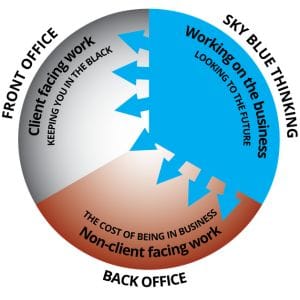
Many of our Accountants’ Growth Club members use meantime to make it easy for staff members and themselves to complete their timesheets. This is a great discipline to do personally so you can see exactly where you are spending your time. If you are like many busy accounting firm owners this timesheet tracking will probably show that you are doing lots of little 5 mins here and there; picking up stuff, putting it down. And struggling to focus on the big stuff that needs to move forward.
Most accounting firm owners find their Blue work takes up less than 5% of their week, and that a startling amount of Red work has accumulated because at some point it was easier to do it than to hand it over. To free up your capacity, start by delegating or automating your Red work, then move on to your Black work. The Accountants Growth Club’s AI group which meet once a month is a great place to learn about what other accounting firm owners are doing with AI to become more efficient.
Your aim is to decide whether each task can be eliminated, automated, or delegated.
Not everything should go, but clear boundaries prevent delegation from feeling like you’re just dumping on your team. Use this quick checklist to sort your tasks:
Remember: You can easily delegate the work and the authority to do it, but as the owner, you remain accountable for the final outcome. This is exactly why the controls in step five matter.
Another thing to be aware of is “organisational hobbies.” Plenty of firm owners keep hold of the website, the social media, the software migration or the office move because they quite enjoy it, or because they think they’re saving money. You’re not. You’re spending your most expensive hours on something a specialist would do better and faster. Your job is to lead the practice, not to be the practice.
Delegation usually breaks down during the brief stage. Why? Because experienced accountants often underestimate what they know automatically.

Remember, your team are not mindreaders, and when they get it wrong it’s usually because you told them 60% of what they needed and assumed the rest was obvious.
When you brief a task, make sure to cover:
Finally, ask the team member to talk you through their approach before they start. This simple step catches misunderstandings early.
You can’t manage everyone the same way, and you can’t even manage the same person the same way across different tasks. Someone who needs no supervision on a set of accounts might need close hand-holding on their inheritance tax planning project.
This is why we always tell our Accountants Growth Club members to adjust how closely they supervise people based on their experience with that specific task:
The common mistake is picking one style and applying it to everybody. For example, one of our Accountants’ Growth Club members decided that they hated being micro-managed when they were employed and so were never going to micromanage their team members. However this led to their junior trainees often struggling, making mistakes and needing more close support on their work. The club member had to reframe their management style into “we will manage each team member in a way that helps them perform at their best”.
One of the reasons most owners delegate ineffectively is that they’ve handed over the work without handing over any way to know how it’s going. Adding in controls fix this.
Here are some controls to put in place so you have visibility of what is happening:
 Case study: How Guy doubled his practice efficiency by standardising the way his team worked
Guy Robinson, owner of Xebra Accounting, will tell you that standardising his practice’s workflows was one of the most painful things he’s done. It was also the thing that made delegation possible, and he used his Growth Expert to hold him accountable to finishing it.
He started by categorising his services into three types: bookkeeping, accounts and advisory. Then for each individual activity, he looked at how the team currently did it and what a simpler version would look like. In weekly team meetings they took one activity at a time, agreed as a group the most effective way to do it, and documented it. Every activity also got a checklist, which had to be completed before anything could be reviewed or sent to a client.
With the team coding their time by client activity, Guy could see for the first time exactly how long each job took and who his most efficient people were. Between standardising the way everyone worked, tackling individual performance issues and getting consistency across the whole team, his practice efficiency nearly doubled, from £20 per hour to £37 per hour.
 Written by Becky Rogers. Becky has spent the last 10+ years writing copy and content for Accounting firm owners and Accounting specialists. Over the last 5 years she’s written copy for over 30 accountants’ websites. Connect with Becky on LinkedIn.