
Updated 10th August 2026
Author bio: Heather Townsend is the founder of The Accountants’ Growth Club, author of The Accountants’ Millionaires’ Club and the leading business coach for accountants.
After you pass the £500k turnover mark in your small accountancy firm, growing, leading and managing your firm gets easier. Not easy, but easier. After all, to get your firm to this point, you have had to master many of the skills required by an accountancy firm owner, i.e. business development, leadership, management, workflow control etc. The next stage of growth for your firm (that is, how to grow your firm from £500k to £1m) is to get the firm to truly run without you. This article explores what changes need to happen to get to this much-wanted state.
Key Takeaways
-
Scaling changes from operational challenges to cultural priorities: Getting to £500k was about building a team and fixing profitability. Growing to £1m is about building a culture where your team behaves correctly and efficiently without your constant supervision.
-
Profitability should now fuel your vision: At £500k, the days of scrambling for cash should be over. You must ensure your profit margins allow you to reshape the practice to fit your goals, whether that means hiring a practice manager, buying a building, or selling off non-ideal client portfolios.
-
Tackle ‘dysfunctional stars’ immediately: High performers who refuse to follow processes or who damage team morale are a major bottleneck at this stage. Ignoring their behaviour signals to the rest of the team that your standards are optional.
-
Stop ‘upwards delegation’: If your team constantly brings you their problems to solve, the practice will never run without you. You must adopt a coaching approach to force them to become self-sufficient decision-makers.
-
Remove yourself as the technical bottleneck: You cannot be the only person who reviews and signs off work. You must develop a technical expert within your team who has the capability and temperament to sign off work before it reaches the client.
-
Plan for turnover, not permanence: Once your headcount exceeds 10, staff turnover is inevitable. You must constantly plan for capacity, anticipate leavers, and consider alternative resourcing models like offshoring to protect your firm from sudden talent shortages.
How to grow your firm from £500k to £1m
You need to make sure that the practice is delivering for you
As your practice grows, it becomes far too easy to become a busy fool. I.e. your revenue line may look really healthy, but your profit line is anything but healthy. Putting on top-line growth is, for an accountancy firm owner, comparatively easy. But servicing this business profitability is not always a given. This is why we check in our FREE Growth Readiness Assessment for our Pillar 5: Owner Time and Role Clarity. I.e. is the practice delivering for you? Are you doing the right stuff? Or are you working long hours and shouldering the burden of delivering the majority of the work for your firm’s clients? The assessment takes 5 mins to do with less than 35 questions to answer. You’ll get a personalised report showing you exactly where to focus your efforts to grow your accounting business.
At this point, you may still be ‘investing’ in your business by adding in extra people and software. But at some point, this investment needs to pay off. And, it’s your role to make sure that this investment does pay off! Typically, profitability in a growing practice is often at its lowest at around £250k. By the time you get to £500k, your profitability should be increasing from this low.
When you get your firm to £500k+, the reality is that there should be enough profit margin to make the shape of the practice fit your personal goals and aspirations. For example, this could be bringing in a practice manager to run the practice and free you up to spend time with clients. Some of our members when they have got to £500k+ have realised that they have a segment of their client portfolio that no longer fits with the business they want to be. As a result, they sell part of their client portfolio to reshape their practice so it fits with their vision.
How will you make your extra profit work harder for you?
When you get your practice to £500k, you will (ideally) have the benefit of more profit and cash. If you have grown your firm sustainably by £500k, the days of worrying about making any money or scrambling for cash should be over. Many firm owners will use this extra cash to help them benefit their firm going forward. For example:
- Buy their office building
- Acquire another practice or book of business
- Invest in other businesses
- Invest in property, e.g. holiday lets, buy to let.
There is no one right answer or way to make your money go further. But if you have the luxury of cash reserves, it’s a shame to stick in a bank account and get diddly-squat in interest.
 After Naveed Mughal, founder of Accurox, grew his accounting firm to nearly £500k he decided to grow by acquisition. I.e. a ‘buy and build’ growth strategy for an accounting firm. Here’s his growth story where he took his business from £50k to over £300k in 3 years.
The firm’s culture is now top of your priority list
If getting your firm to £250k was all about building out a team, then getting the firm to £500k would have been all about growing that team and sorting out profitability. To make the next jump (how to grow your firm from £500k to £1m), you now need to focus on creating the right culture.
Your firm’s culture is about what is acceptable ways to behave or work. Or another way of looking at it, the worse behaviour you will tolerate! As you probably have 10+ people in your accountancy business, it isn’t possible to drive every aspect of your firm by the force of your personality. This is why your firm culture is so essential. Don’t get the right behaviours happening automatically in your firm and you will find this will come back to haunt you as you grow further.
Here are some real examples of where our £500k+ members are trying to sort out their firm’s culture:
- Client managers not taking control of their workflow, i.e. the work that “needs to be done” tends to be driven by regulatory deadlines. The result is that work is being done for those who shout the loudest rather than delivering excellent client service.
- Timesheets were not being completed regularly or accurately, so it became difficult to see where there were efficiency issues or where clients needed a pay rise.
- Client managers did not see the urgency to complete jobs and bill promptly so large amounts of WIP built up and the firm dipped more and more into its overdraft.
- Staff deferred to the practice owner to answer client queries which lead to the practice owner working long hours and continually being on the phone with clients.
 Case study: Sian Kelly Inform Accounting
 Case study:
By the time Sian joined the Accountants’ Growth Club, she’d already built a solid business. But she knew something had to change if she wanted to get past the half-a-million mark. “I was always a strategist, not a doer,” she explains. “But stepping back is tough when clients and staff want you involved in everything. The club helped me see that for us to grow, I needed to become the CEO, not the bottleneck.”
With the support of the club, Sian started building a proper management team and letting go of more client work. It wasn’t easy, but it was essential, and the club gave her the tools, structure, and coaching to do just that. She began hiring senior team members – the most notable, her first outsourced marketing director (when the business was still under £500k turnover) – and investing in cloud-based technology such as Xero, Karbon, and Fathom to streamline workflows and automate repetitive tasks.
The result? More time to focus on business development and more capacity to take on acquisitions.
Inform Accounting now has over 30 team members, a £1.5m turnover, and several awards under its belt, including recognition for client service and digital innovation.
With a focus on cloud technology and a strong management accounting division, Sian’s firm stands out by offering a forward-thinking, advisory-led approach. “We’re not just about year-end,” she says, “We’re about helping clients run better businesses every day.”
Over the last decade, Sian has led the firm through four successful acquisitions, transitioning several traditional, paper-based practices into her cloud-first model.
Key stats:
- £500K to £1.5M Turnover in 4 years: Through a combination of acquisitions and organic growth.
- 4 successful acquisitions: Each one adds new clients and helps establish new service lines.
- Team growth: From a team of 10 to over 30 staff members, many of whom started as apprentices.
Read more about Sian’s journey to grow her accounting firm from £500k to £1m here or watch the whole of her growth story:
You will need to get ‘hot’ on performance management
When you have just a handful of staff, it is fairly easy to see who is not pulling their weight. But when you get above 10 people with not everyone reporting to you, it’s much easier for low performance to get hidden. This means:
- You need to be able to measure how people are performing.
- Setting up regular (weekly, monthly and quarterly) conversations with your direct reports to see how they are doing and what you can help them with. If your team members’ commitment or competence is low, these meetings will need to be longer and potentially more frequent. Ensuring that the people in your team who have direct reports are also doing this with their team members.
- Feedback – both positive and developmental – needs to be given regularly to your team.
At this stage of your growth underperforming team members are often the biggest drain on your firm’s efficiency and bottom line. Most underperformance issues can be nipped in the bud or rectified easily if picked up quickly, but often, these performance issues are allowed to fester. Or they are just not noticed. The reality is that staff performance issues normally:
- Get worse.
- Cause you increasing amounts of stress the longer you ignore them.
- Impact others’ work ethics and standards, i.e. damage the culture of your firm.
- Trigger client or employee churn.
This is why we check in our FREE Growth Readiness Assessment in our Pillar 3 – Capacity and team performance, for how well your team are delivering for you. Get this right and your accounting firm will grow from £500k upwards.
Dyfunctional Stars
It’s not uncommon to find you have dysfunctional stars within your firm. In other words, really high performers, but not in all areas. These can be staff members who:
- Are excellent at some stuff but cause you problems with other stuff, such as not working within the values of your business. They often tend to have a reasonable sized client portfolio!
- Decide to cherry-pick which parts of the role they want to do. For example, do they want the title and status but not want to do the whole demands of the role that come with the job title? (We’ve had this!)
- Could be normally excellent and all-around great performers but are burning out, burnt out or handling large issues outside of their work lives.
Dysfunctional stars are a nightmare! An easy way to identify a dysfunctional star is where the team members say, “[name of star] they are really good/brilliant, but….” or “I know [name of star] is good/brilliant but why are they allowed to get away with….“, or “oh that’s just [name of star], we let them get on with stuff.”
On the one hand, particularly if they manage a large client portfolio, you don’t want to upset them so they leave. But you also need to tackle their areas of non-compliance or poor behaviours. If you leave them alone and don’t get to grips with their problems, you will signal to other members of the team that you are approving of their behaviour. This tends to lead to a downward spiral of other team members’ behaviours too.
Stop any upwards delegation
If you are going to have a business that runs without you, your staff and leadership team need to be self-sufficient. What can often happen is the owner of a small accountancy firm keeps on getting drawn back into the business. This is often because of something called upwards delegation. I.e. where team members come to you with their problems and you train them to expect that you will solve their problems for you.
What I am NOT saying here is for you to adopt old-school leadership theory where you tell staff “don’t bring me problems, bring me solutions“. This is because your staff will learn to not speak up when they notice a problem. The answer here is to adopt a coaching approach when your staff members come to you with a problem or query! (Learn how to get your employees to take initiative)
For example:
Thank you so much for raising this and bringing it to my attention. I’m going to ask you a series of questions to see if we can both work together to find a solution. e.g:
- If you were in my position what would you do?
- If I wasn’t here, what decision would you come to?
- What do you think the first action you would take would be?
This IS how to grow your firm from £500k to £1m!
Identify who is going to review the work before it goes out to clients
Yes, it’s your name on the Practicing Certificate and professional indemnity insurance. But if you are the only one who can review and sign off work, then the growth of your practice will plateau! This means that over time, you need to develop a ‘technical’ expert in your team who has the capability and temperament to review the work before it goes out the door to a client.
Capacity and resource planning is vital
When we start our practice, it’s easy to get into the mindset that when a person joins your firm they are going to be there forever. But that’s just not realistic! If you want to know how to grow your firm from £500k to £1m, you need to foster the mindset that when you hire a person, they will leave at some point.
When your headcount gets over 10, there will always be starters and leavers in your business. It could be the apprentice who, when they qualify, get lured away by the bright lights of a bigger firm. Or the member of staff who gives up work to care for an elderly relative or young family. This means part of your role now involves considering who needs to be your next hire, what they will do and when you need them up to speed.
At the time of writing, there is a severe shortage of accountancy talent. This means that firms are seeing higher than normal staff turnover plus a longer lead time to recruit new staff members. It also means that you may need to consider other resourcing routes, such as offshoring or outsourcing.
In fact, one of our members had nearly all of the accounts team leave within a 3-6 month period. This left a massive backlog of year-end accounts which just couldn’t be finalised with the remaining members of staff. As a result, this firm turned to an outsourcing company to help them fulfil their client obligations. Although it was a temporary fix, it worked so well for them that they have now radically re-engineered their practice to take advantage of offshoring and outsourcing on a regular basis.
The seniority gap and other organisational structure problems holding back the growth of your accounting firm
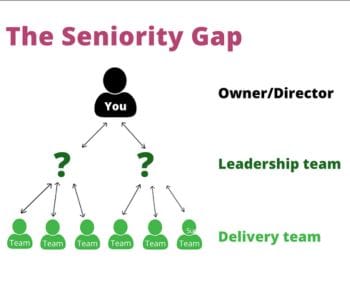
It’s very easy when growing your accounting firm to keep on adding on people that report into you. After all, the desire to stay in control is strong. This often leads to what is termed by HR and organisational design experts a problem with your spans of control. I.e. you have too many people reporting into you. When you have too many direct reports your day job starts to become people management. And yes, as this article has said, your key leadership priority is talent management. But too many people and you don’t have time to work on the business. You will be too focused on doing the people management to get all your direct reports to perform well.
As your accounting business growths from £500k to £1m you need to keep an eye on your firm’s structure. There are many reasons why you may break your firm’s structure and introduce inefficiencies:
- You acquire books of business but not the client manager to deliver this work. You may only acquire junior team members as part of the acquisition so end up with a large delivery team all reporting into you.
- Creating ‘bespoke’ roles to keep team members happy. With the dire shortage of good team members no-one would blame you for wanting to keep a good team member. But often that team member is only good at parts of the role. So you adjust their role to play to their strengths. This works well for a short term, but can then end up with a unwieldy firm structure with muddled up reporting lines and inefficiencies hardbaked into your business.
Grow your accountancy firm to £1m
If you’re really wanting to grow your firm from £500k to £1m, you will need to get these 7 areas down. If you don’t, it will be impossible to make this jump and sustain this growth for the long term.
Frequently Asked Questions
Why does growing an accountancy firm past £500k feel different to earlier stages?
Because the primary challenge changes from business development to people management and culture. Getting to £500k requires mastering workflow and building a team. Pushing to £1m requires getting that team to function entirely without your day-to-day involvement, which means you have to build a strong, self-sustaining culture.
How do I stop my team relying on me for every client query?
You need to stop accepting ‘upwards delegation’. When a team member brings you a problem, do not just give them the answer. Instead, ask them coaching questions like, “If I wasn’t here, what decision would you make?” This trains them to become self-sufficient and stops you working long hours answering routine queries.
What should I do if a top-performing staff member won’t follow our firm’s processes?
You have to manage them firmly, even if they control a large client portfolio. We call these individuals ‘dysfunctional stars’. If you let them cherry-pick the rules they follow, it destroys your firm’s culture and drags down the standards of the rest of the team. Performance management at this stage of growth must be consistent across the board.
Do I still need to review all client work before it goes out?
No. If your name is the only one clearing work, your firm’s growth will permanently stall. To scale to £1m, you must train and trust a technical expert within your team to take over the review and sign-off process.
How do I handle staff turnover when my team gets larger?
You need to accept that staff will leave and bake that reality into your capacity planning. With a team of 10 or more, you will always have starters and leavers. Do not wait for a crisis to recruit; constantly plan your next hire and ensure your processes are robust enough to utilise offshoring or outsourcing if you face a sudden talent gap.
 Author bio: Heather Townsend is the founder of The Accountants’ Growth Club, author of The Accountants’ Millionaires’ Club and the leading business coach for accountants. She also wrote Profitable Pricing for Accountants, The Financial Times Guide To Business Networking and The Go-To Expert. Listen to her “Start up to grown up” on substack, apple podcasts and spotify.