
Written by Becky Rogers, copy and content writer for Accounting firm owners and Accounting specialists.
You finally built the firm you set out to build. You’ve got the team, the clients, the revenue you dreamed about three years ago. So why do you wake at 3 AM anxiously thinking about payroll, feeling more trapped than you ever did before?
If your stomach drops when the monthly salary bill lands, or you feel you can’t talk to your team or peers about your fears, you aren’t failing. You are simply experiencing the “Paradox of Scaling”.
Recent data from TaxCalc’s The Accountants’ Voice report shows that 86% of accountants report stress or burnout, and nearly 9 out of 10 accountants have faced significant struggles with their mental health. When it came to the reasons for struggling with stress, too much work was the most popular response, with 36% saying so. Client interactions were the second most common at 34%.
This was no surprise to us as we see it time and time again with our Accountants’ Growth Club members when they first come to us. Why? Because for those leading a growing accounting firm, the pressure only intensifies as you grow. 
You’re not just managing your own workload anymore; you’re responsible for your team and the families who depend on those salaries. Many of those who are leading a growing accounting firm make a simple mistake. They assume that they bigger they get, the quicker the problems will go away. As Paul Wareham, club member of The Accountants’ Growth Club, and owner of a growing accounting firm which has grown by over 4 times in 7 years discovered, problems just get bigger as you grow. He found that you can only scale smoothly if you have a firm foundation to scale from. Sticking your head in the sand only serves to exacerbate any problems.
Very often, spending 5 minutes completing our free Growth Readiness Assessment will show where these problems are hiding.
The good news? This overwhelming feeling isn’t a sign that you’ve made a terrible mistake growing your own firm. It’s a sign that your business has outgrown your current business model and your roles and responsibilities need to change.
Here’s how to regain your mojo when leading a growing accounting firm (and why the rules of the game fundamentally change at scale).
“What got you here won’t get you there”…this is what we continuously tell our Accountants’ Growth Club members. Because when you’re in the thick of leading a growing accounting firm, it’s really easy to forget this simple fact.
What we mean by this is, the habits that built your practice – saying yes to everything, working weekends, being the heroic “doer” who saves the day – will actually break the business at this new stage. Working harder and longer may have got you here, but if you want to get there (i.e. the next stage of growth), you can’t keep doing what you used to do. There aren’t enough hours, and you’ve already squeezed every drop of productivity from your schedule.
As a result, accounting firm owners then experience what is known as “The Paradox of Scaling” where growth has created problems such as decreased efficiency, slower decision-making, and lower quality.
 Paul Donno, owner of 1 Accounts, experienced this Paradox of Scaling. In his growth story, you’ll hear how he had to start his business from scratch after a disastrous business merger.
As with his previous practice, 1 Accounts Online grew fairly quickly, but in 2018 he found himself in a Groundhog Day moment, struggling to get to the £300k mark. He decided to seek help from the Accountants’ Growth Club to get above this ceiling as previous experience taught him a sale or merger was not the right solution. Knowing he wanted to do things differently, he started work with The Accountants’ Growth Club. He couldn’t see how to get 1 Accounts Online above £300k, but was willing to have a go at smashing what turned out to be a perceived ceiling.
As you’ll see from Paul Donno’s Growth Story, he had to realise that he had to change his role and what he did with the practice. Read more here
Nobody prepares you for what actually changes when you cross the threshold from “small practice” to “growing firm.” It isn’t just a change in revenue; it’s a total change in your daily reality. You aren’t just facing bigger versions of old problems; you’re facing a brand-new set of structural and psychological hurdles that require a completely different leadership mindset.
In the early days, if you had a poor billing month, you knew exactly what to do: work longer hours, maybe a few weekends, chase a few extra clients, deliver that project faster. You could essentially “trade” your way out of it.
 Now? The financial obligations require planning for, not just elbow grease.The payroll has to be met regardless of whether it’s a good month or a bad month. The office lease doesn’t care about seasonal fluctuations. The software subscriptions, the professional indemnity insurance, the tax bills…they all land with what feels like relentless regularity.
When we surveyed Accountants’ Growth Club members during our “Stop the Overwhelm” webinar, this was the number one source of anxiety for those leading a growing accounting firm: the mental load of constant financial responsibility.
This same pattern is seen across the industry too. When you’re carrying significant overhead, the fear of getting it wrong when families rely on your firm for their livelihoods creates a constant low-level anxiety that never fully switches off. 45% of accountants experiencing burnout said that it impacts their ability to work or prompted time off. This then makes taking time off feel impossible, which accelerates the burnout cycle.
A firm turning over £150k faces entirely different challenges than a firm scaling past £600k or £1 million. This is why in our Accountants’ Growth Club special interest groups we have our AGC100 group for members who are typically under £150k and dealing with the challenges of confidence, imposter syndrome, winning more business and starting to find their first team member. Then we have our AGC500 group which is for members over £150k who are mostly wrestling with the toxic mixture of learning to lead and manage people, get bigger and better clients, get the systems in place and still find the time to see their family!
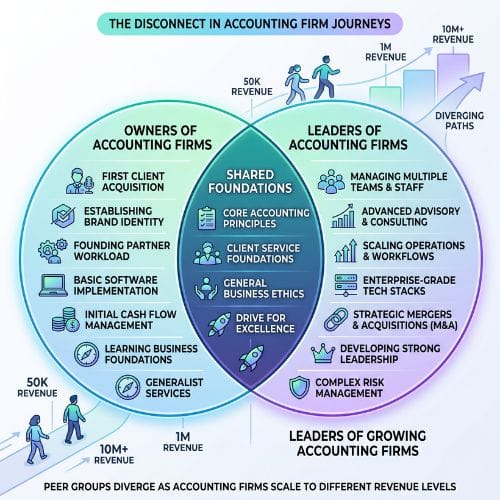 While your old peer group is excited about a £5k client, you’re wrestling with whether to fire a toxic £20k client. While another peer is talking about whether to hire a second employee, you’re now managing a team of seven and trying to build a leadership structure that doesn’t depend on you for every decision. While they might be figuring out cloud accounting software, you’re implementing proper financial forecasting, considering premises moves, and trying to understand when you need an HR consultant.
It’s hard when you’ve entered a different league with different rules. The conversations that energise them don’t address your current challenges, and the advice they offer doesn’t scale to your reality.
This compounds the loneliness. Not only can’t you talk to your team, but you’ve also outgrown the peer group who used to understand you.
Every new revenue milestone reached can make you feel like a fraud. Like you somehow tricked everyone into thinking you know what you’re doing.
At £150k, you felt competent. At £300k, you started second guessing yourself. After all, your team look up to you as “the boss” but do you feel like “the boss”? At £600k? You’re worried that you might lose it all. So you might start playing small or you might tell yourself, “I’m just an accountant who got lucky,” or worry that you lack “formal” business training. If this is you, the Accountants’ Growth Club runs professional designed and delivered training programmes throughout the year to help you develop your skills as a business owner. These are included in your membership if you are a Grow or Boost member, or you can pay to just attend this training programme.
The reality of leading a growing accounting firm is that you are no longer succeeding based on technical ability alone. You are now required to learn strategy, team psychology, HR, and sales systems on the fly, and that’s why you feel like a fraud. Because the skillset you need fundamentally changes (and you most likely don’t have all those skills yet).
One of our Accountants’ Growth Club members described this perfectly during a coaching call. She said: “I can prepare complex accounts in my sleep. But when my team looks to me for decisions about restructuring or expansion, I feel like I’m making it up as I go along.”
She wasn’t making it up. She was learning. But because she’d never had formal CEO training (who does?), she assumed everyone else had some secret playbook she’d missed.
While it may seem like everyone else knows exactly what they are doing and they have it all together, we can tell you for a fact that they are figuring it out as they go along and painfully learning on the job too. That’s why our members asked us to give them training programmes as part of their membership. They wanted the confidence to lead and manage their people, to know what to do and what not to do to win business.
The Accountants’ Growth Club training programmes are designed around the needs of a busy accounting firm owner. The programmes are split into bite-sized chunks with a weekly group call to keep you moving forward. There are even implementation weeks built in so you wouldn’t fall behind. If you paid for one of our programmes with another provider you’d typically be spending £2-5k. Membership of the club really does pay for itself many times over.
When you were smaller, you could try new things and pivot quickly. If something didn’t work, you’d absorb it and move on.
 Now? Every decision has more riding on it, both financially and mentally.
This caution can paralyse decision-making. You overthink. You delay. You need more data, more certainty, more guarantees…none of which exist in business. This is why our members love our small special interest groups and the Daily Power Up. They can get instant advice on what they need to move forward with.
Ironically, this “excessive caution” can then actually stall the very growth needed to create stability.
One of the Growth Experts for the Accountants’ Growth Club, had a conversation with a small firm owner who had one staff member. That staff member was due to have a planned operation, and the firm owner was struggling to plan because they didn’t know how long the staff member would be out of the business. Would it be one week? Or much, much longer?
The Growth Expert and their member googled the recovery time and prognosis for this operation. The NHS told us to expect them to be off work for two weeks. Deciding that the staff member would be off for two weeks gave the firm owner the certainty to plan around it.
The point? When you’re leading a growing accounting firm, even small uncertainties feel enormous because the stakes are higher. This is normal. It doesn’t mean you’re being overly anxious. It means you care about getting it right.
If you feel like you have lost your mojo and you’re drowning in the day to day, the solution isn’t to “push through” or scale back; it is to shift how you operate within the business. To break the cycle, you must fundamentally shift your identity from “accountant who runs a practice” to “business owner who happens to be in accounting”.
What got you here was being an exceptional accountant who could outwork everyone. What will get you to the next level is becoming a capable leader who can win work, service clients, build systems and develop people.
This requires mourning the loss of your simpler early days of running your accounting firm. You can’t go back to being the firm where you knew every client personally, handled most of the technical work yourself, and made decisions on instinct.
You’re now leading a growing accounting firm and that requires a different mindset, role and operating system.
This isn’t about abandoning your technical expertise. It’s about recognising that your primary value is now in:
 Naveed Mughal, founder of Accurox had to realise that as his firm grew his role needed to change. In the early days, Naveed wore too many hats, which led to burnout and inefficiencies. He now knows that delegating tasks to capable team members sooner would have given him more space to focus on planning and growing the business. For more about how Naveed has grown his accounting firm from £50k to now over £1.5m (via 3 acquisitions) read his growth story.
One of the reasons we get easily overwhelmed when leading a growing accounting firm is that we believe we just need to work harder. But what happens if you’re already working long hours? Or if busy season seems to be all year round?
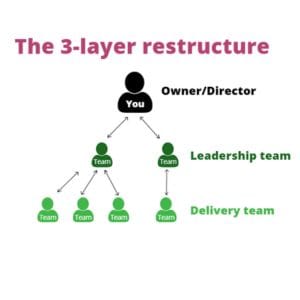 To get to the next level, your role needs to change. Try this exercise which our Growth Experts often use with their members:
This exercise often reveals a gap between where your time goes and where it should go. It also gives you a mandate for what needs to change.
You cannot navigate this transition in isolation. You need people who understand the specific challenges of leading a growing accounting firm, not the challenges of starting one.
This means deliberately seeking out firm owners who are:
54% of accountants experiencing burnout said it affected their ability to maintain a healthy work-life balance. At the Accountants’ Growth Club, we’ve seen that having the right peer support dramatically reduces this impact because you stop carrying the burden entirely alone.
Time is finite, and you only have a finite number of “yeses” in a day. Every “yes” to a request potentially means a “no” to something else, so you want to save the “yes” for what’s truly important.
 When you’re leading a growing accounting firm, guard your time by:
Being disciplined about your time isn’t selfish, it’s necessary for the business to function at this level. Otherwise, you’ll find that everyone else will run your schedule for you.
Everyone has beliefs. Sometimes they’re helpful. Other times, less so.
Ask yourself:
These beliefs often operate unconsciously. When you’re leading a growing accounting firm and feeling stuck, it’s worth examining which beliefs are serving you and which are holding you back.
Here’s what we at The Accountants’ Growth Club have learned from working with hundreds of accounting firm owners navigating this transition: you can’t avoid the evolution. Your business has grown and the “simple startup” days are gone, and while that transition is uncomfortable, it is a sign of your success, not a lack of capability.
To get to the next level, and reclaim your time and passion, you must move from being the “heroic doer” who saves the day to the leader who develops capable people. To do this often means getting outside help from an organisation such as The Accountants’ Growth Club who can help you overcome your limiting beliefs, reduce your overwhelm and start enjoying running your firm again.
Remember, you don’t have to maintain the facade that everything’s fine while drowning quietly. You don’t have to try to figure it all out alone. Most accounting firm owners are figuring it out as they go too, so it’s really valuable to connect and learn from them.
a
 Written by Becky Rogers. Becky has spent the last 10+ years writing copy and content for Accounting firm owners and Accounting specialists. Over the last 5 years she’s written copy for over 30 accountants’ websites. Connect with Becky on LinkedIn.