
a
The best KPIs for your accountancy firm should be:
Think of KPIs as progress trackers. They tell you how your firm is doing and whether adjustments are needed. Unlike endless discussions, KPIs guide and prompt action. In an ideal world, you should aim for KPIs that take no more than two or three clicks to track.
I could be wrong, but I think that most of the time, this obsession isn’t really about measurement. It’s about benchmarking their accounting firm.
 You want to analyse your figures. You want to know where you sit in the pack. Are you ahead? Behind? Doing better than the firm down the road? There’s a pull to find the “correct” numbers so you can measure yourself against everyone else. But isn’t this what has made you a good accountant to date?
The problem is that your role when you’re growing your accounting business isn’t about being a great accountant. It’s about profitably and sustainably growing, then scaling your accounting firm. You’re here to lead your accounting business, not be the best accounting professional in it.
Whilst benchmarking your firm against others may give you some insight or peace of mind, it’s not going to help you achieve your own goals. What other firms are doing or not doing isn’t going to help you hit your accounting firm’s KPIs. As I say many times, if you’re going to grow your accounting firm successfully, you need to focus on your firm, your goals, and your aspirations. In other words, stay in your own lane.
Let’s take the obvious first. You’re accounting professionals, so you’ll be monitoring your own P&L. Perhaps not as much as you’d like, but you’ll be looking at:
These are important numbers, but they only tell you how your decisions in the past have worked out. Or possibly not!
The first place to start isn’t your accounting firm KPIs. It’s actually your 3-year growth plan. Because everything you do should be driving you towards achieving it.
Why three years? Because it’s long enough to see the bigger picture and hold the long term and the short term in focus at the same time. Go much beyond three years and the plan dates too quickly. Or it starts to feel so distant that it’s unachievable. You may argue that three years is too long given the volatility in the current market conditions and geopolitics right now. That’s exactly why you revisit the plan every 90 days rather than filing it away.

Your growth plan should contain your big bets. The main levers you’re going to pull to hit your numbers.
In my Accountants’ Millionaires’ Club book (Click here to get your copy of the book for free, just pay postage and packing) I call these core “Themes.”
Your Growth Plan Themes will be broad in nature, but there should be general agreement that they’re the best things to work on and the quickest, most effective way to grow your accounting practice sustainably and profitably. Things like:
Once you know the bigger picture, i.e. your 3-year growth plan for your accounting firm, and you know what your big bets are, you can set the objectives that will get you there.

These should be fairly high-level.
For example:
Have you noticed how specific those two examples are?
Too often when we’re thinking about our accounting firm’s growth plan, we’re far too vague. For example, if you want your main route to market to be referrals from existing clients, how many referrals do you want each month? And at what average fee?
a
Once you have decided on your accounting firm’s 3-year growth plan, it’s time to set your firm’s ONE BIG FOCUS. This could be one of your core Themes, or a pressing priority that needs fixing urgently. For example, if you lost a few of your big clients in the space of a few months, your ONE BIG FOCUS may well become winning new business.
It’s very easy to overestimate what we can do in the short term, and underestimate what we can do in the long term. When you’re really, really busy, it’s so easy to get overwhelmed. Often because everything feels urgent. This is where your ONE BIG FOCUS comes in.
It’s your ONE BIG FOCUS that determines the KPIs you measure for the next 90 days. Say the biggest thing for your firm to fix is generating more revenue. For example, winning £1.5k of MRR a month. That means every KPI in your business needs to point at that target, at firm level, team level and an individual level. This alignment reflects wider industry reality: while 38% of accounting firms cite revenue growth as their primary goal, 35% recognise that client service engagement is the actual operational driver needed to achieve it.
Let’s say your ONE BIG FOCUS is to generate £50,000 extra GRF within the next 90 days. The first thing you do is ask, “What are we going to do to achieve that?” And right behind it, what do we need to measure to know it’s working?
Let’s work through that £50,000 example. It means winning £16,667 of new business each month. If your firm’s average fee per new client is £3,600, that’s 5 new clients a month. But what if you decide some of those new fees will come from upselling more services to existing clients? Bookkeeping to clients who don’t currently take it, for example. As a firm owner, I’d probably know that my best route to market was picking up the phone to existing clients and running pre-year end meetings. And I’d be targeting my team on the following:
So, if I were measuring the success of the plan to win that £50,000, I’d be tracking:
Finally, my team would have individual targets along these lines:
This builds on the classic management framework featured in the Harvard Business Review, which proves that managing daily activity metrics drives far better growth than only monitoring past financial outcomes.
So what’s the difference between leading and lagging indicators, and why do you need to understand them?
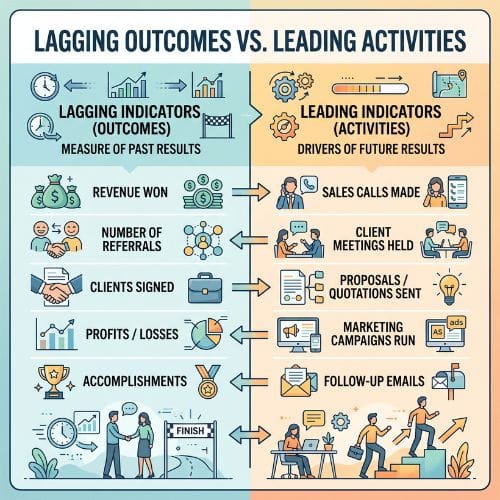 Lagging indicators are the outcomes (the number of referrals, or the revenue you won, etc).
Leading indicators are the activities people do to produce those outcomes. When you think about KPIs at a firm level, you want to measure the outcomes (the lagging indicators).
Such as:
But what you want your team measuring is typically the leading indicators. The activities they’ll actually do. A team member who isn’t involved in winning new clients still has a part to play in business development. So the conversation with them is different. What does great client service look like? What is it that you need to do? And from there, you can start to put KPIs around those activities.
In the example above, the leading indicators for the team are prompt responses to client emails, the number of client conversations, and asking clients “Is there anything else the firm can help you with?”
Deciding on your ONE BIG FOCUS and then the KPIs for the firm, the teams and the individuals isn’t the end of it. You need your team to buy-in to those targets.
A good way to do that is through your rhythm team meetings. These are a regular series of meetings held across your accounting business. Done well, they:
For your guide to running Rhythm meetings, including the agenda, click here.
Your rhythm team meetings, your all-team meeting every quarter and your monthly leadership team meeting are your opportunity to:
Now, there are times when your team doesn’t know what it doesn’t know. They may think they have a great idea, but you know it’s not going to work. There will be times when you have to set a target your team doesn’t like. And that is how it needs to be.
For example, one of our Accountants’ Growth Club members set a target to turn year-end accounts around within 4 weeks of the information arriving. It finally gave him visibility of what work needed doing, the monthly capacity his firm required, and what the firm would bill, as he still had a significant number of clients paying “on completion”. His team were sceptical at first, because they’d always worked on the basis of which client was shouting the loudest. He had to push the new way of working through. It took a few months, but his team came round to it and started to see the benefits.
Your KPIs now need to be distilled down to individuals in your business. That process, and that conversation, happens through quarterly reviews with each team member.
In these reviews, you want to talk about:
Any KPI that you track should be linked to your ONE BIG FOCUS. When choosing KPIs, look for those that reveal several things about your firm at once. Here’s an example:
% of firm capacity used for chargeable work: this tells you about profitability and efficiency, revenue, and whether it’s time to hire.
Here are some good KPIs to track:
 Average time to complete a set of year end accounts after a clients’ year end.
This is an operational KPI that tells you several things: your operational efficiency, the communication between clients and staff, and your capacity.
This gives you an indication of the capacity in your bookkeeping team, the efficiency of that team, and the level of proactive communication between them and their clients.
Ideally, this figure should cover your normal monthly costs such as wages, rent, rates and software. Once it does, it becomes much easier to grow your accounting business, because you’re not chasing ad hoc or ‘pay on completion’ work each month just to pay the bills. You’re not relying on clients bringing their information in on time either. Your cash flow is smoothed out across the year.
As highlighted in Xero’s guide to practice management, securing steady recurring revenue is the most effective way to smooth out billing seasonality and stabilise cash flow. Not just that, but industry benchmarks recommend targeting 40% to 60% of total firm revenue from predictable, recurring sources to protect against seasonal billing slumps.
The best way to track client service is through referrals. When your firm’s client service is good or excellent, referrals come in naturally. In fact, in my opinion, client referrals are a more accurate predictor of client satisfaction than any client satisfaction survey. Industry research confirms this emphasis: 58% of business clients discover their accounting firm through peer referrals, compared to just 3% from traditional advertising, making referral tracking your most critical growth indicator.
Here you track the % of clients who stay with your firm over a defined period, say 12 months or 24 months. A declining rate is an early warning of problems in your practice. Maybe it’s a team member struggling, or your clients starting to retire. Because acquiring a new client costs 5 to 7 times more than keeping an existing one, elite practices maintain a target retention rate between 85% and 95%.
This gives you a view of where you have opportunities to upsell or reprice existing clients. But the real value of this accounting firm KPI comes when you drill down into segments of your client base. The clients on different packages, or the clients not taking anything more than compliance
You will automatically be measuring your firm’s revenue and profit. But the top line figures can often hide an underperforming service line. A common one is where a firm has a bookkeeping team that is making a loss.
The Accountants Growth Club members that make the quickest progress aren’t the ones tracking the most numbers. They’re the ones tracking a handful and doing something with them every week.
So work from the top down. Your 3-year growth plan tells you where you’re going; your big bets tell you how you’ll get there, and your ONE BIG FOCUS tells you what matters over the next 90 days. Only then do you decide what to measure, at firm level, team level and individual level.
When it comes to KPIs, and before anything goes on your dashboard, ask yourself this. If that number moves, will anything actually change in the next week or two? If not, it isn’t a KPI. Your numbers need to be telling you if your accounting firm is on track for where you want it to be in three years’ time, and they need to be actively driving you forward.
 Written by Heather Townsend. Heather has been helping accountants grow their practice for 20+ years. She is the founder of The Accountants’ Growth Club and the author of 6 books, including The Accountants Millionaires’ Club, Profitable Pricing For Accountants and The Go-To Expert. Heather designs training programmes for the club and provides high-level coaching.