Sorting out your business development

Most accountancy firm owners didn’t get into this business because they love sales. But if you want to grow, you can’t avoid it forever.

The trouble is, business development for accountants often feels like feast or famine. You’re either too busy delivering client work to chase the next one, or scrambling because the pipeline’s run dry.

One of the first things we work on with our AGC members is building a business development engine that runs without you having to constantly fight fires.

This means having a clear strategy and knowing what to prioritise, rather than reacting to whatever’s loudest that week. It’s why one of the 6 profit pillars we check in our free Growth Assessment is Pillar 6 – Growth Strategy & Priorities.

How to get your team to see business development as their responsibility too

Written by Becky Rogers, copy and content writer for Accounting firm owners and Accounting specialists.

For many accountancy firm owners, growth feels like a double-edged sword. You want to scale, but you’ve likely hit what we call the “Technician’s Ceiling,” where growth is capped by your personal capacity. You’re stuck in the “Work In/Work On” trap, dragging yourself back into client delivery, which stalls your marketing and leads to a frustrating “feast or famine” cycle. After all, your accounting firm wouldn’t grow beyond a certain level if you are stuck being the star player. 

It’s a common myth that accountants “won’t do sales” because they aren’t pushy. The truth is that your team doesn’t need to become “mercenaries”; they simply need a system that reframes business development as “helping clients to buy”. By leveraging their technical expertise as a sales tool, you can build a firm that grows without you being the only one landing the plane.

Wondering “How to get my team to do business development?” Here’s how to break through the ceiling. 


Key Takeaways: To get an accounting team to do business development activities, owners must move away from a “sales” mindset and reframe the activity as “helping clients to buy”. By breaking the process into a Create It, Convert It, Cultivate It framework, you can delegate technical content, lead qualification, and relationship nurturing to staff based on their natural “superpowers,” allowing the firm to grow beyond the owner’s personal capacity.

The Solo Rainmaker Trap

According to industry research, more than 60% of small- to mid-sized firms cite “capacity of senior leadership” as their primary barrier to scaling. Based on our work with hundreds of accounting firm owners in the Accountants’ Growth Club, our internal data also shows similar results. We found that the hardest stage of growing an accountancy firm is from £150k to £500k turnover. Why? Because this is when the accountancy firm owners enter what we call the Work In/Work On Trap (i.e. they keep getting dragged back into the business, so the practice’s growth stalls).

A man in business attire stands at a desk, leaning forward to look at a computer monitor, and his head is touching the seiling. This represents accountancy firm owners hitting a "plateau" or "ceiling". You probably already know this trap. It’s when every step forward feels like three steps back; minor issues blow up into major crises because you lack the “headspace” to manage them, and everything flows through you (clients, suppliers, team queries etc). Essentially, it feels like you’re drowning.

If you’re the only one bringing in business, your growth is capped by your personal capacity. This is the “Technician’s Ceiling.” When you get busy with client work, marketing stops. No marketing means no leads, and the cycle repeats.

So why does this matter?

The Valuation Hit: A practice that relies entirely on the owner for new business is worth significantly less. To maximise capital value and create a viable exit strategy, the firm must be able to grow without you being present.

The Bottleneck Effect: If you’re the only one who can close a deal, you become the bottleneck. This means that small issues can often escalate into crises because you’re spread too thin. The firm’s momentum stalls.

To stop these regular crises, you need to systemise what you do and have one way of working. You need a team that can handle business development alongside you.

a

Why is it so hard to get my team to do business development?

Most accountants didn’t enter the profession to be salespeople. So, as a result, they fear rejection and being perceived as “pushy” (and their teams feel the same).

We hear from Accountants Growth Club members time and time again: “My team just won’t do sales.” And every single one of them who said that has gone on to “eat their hat,” as the saying goes.

This is because we teach them how to properly train their staff to sell. Here’s how to do that in three steps:

1) Reframing the role

Stop using the word “sales.” Reframe the activity as “helping clients to buy.” Your team needs to understand that BD is simply diagnosing a problem and offering a solution, not pushing a product.

2) The fear of “Selling”

Staff often resist business development (BD) because they equate it with the “used car salesman” stereotype. You must educate them that their technical knowledge is their sales tool. Clients buy expertise and trust, not sales patter.

3) Finding the superpower

Not everyone needs to close deals. Some are better at research, some at relationship nurturing, and some at technical content. You must identify what they are naturally good at rather than forcing them into a “rainmaker” mould.

a

How to get my team to do BD: The Create It, Convert It, Cultivate It Framework

If you find yourself constantly wondering “how to get my team to do business development,” you’re like most Accountants’ Growth Club members. 
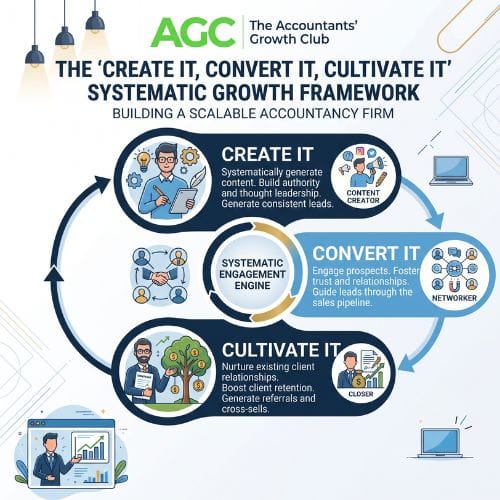
A branded infographic of The Create It, Convert It, Cultivate It framework for building a business development team in an accounting firm.Here’s what we tell them: you cannot expect a new team member to immediately possess your level of gravitas or closing ability. I know, it’s a shame, but that’s just unrealistic. 

Instead, the most effective way to get your accounting team to do business development is to break the process down into three stages: Create It, Convert It, Cultivate It. When you do this, you can build your business development team within your accounting firm without hiring a business development or sales specialist.

1) Create It: Generating the lead

This stage covers everything your practice does to generate a fresh client enquiry. Your team can contribute here without the pressure of “selling.”

The Content Creator: Instead of forcing staff to “sell,” assign them to write technical updates or blog posts based on real questions they hear from clients. This gets them to use their technical expertise to help your accounting firm’s marketing without the pressure of feeling they need to be involved in sales. If they tell you “I’m not good with words that’s why I went into accountancy” then help them use AI to create a credible first draft for them (and you) to polish and make it sound like the firm rather than ChatGPT or Claude. 

The Networker (Junior Level): Allow junior staff to develop relationship management skills by acting as the “Relationship Lead” for your B-Lister or C-Lister contacts. They can manage follow-ups, send birthday cards, and maintain the relationship without needing to close deals.

Support Tasks: You can delegate or outsource the routine “admin” of networking, such as:

  • Researching people for you to meet
  • Managing your CRM
  • Entering contact details from business cards
  • Running reports from your CRM software
  • Updating your social media profiles
  • Posting your articles on blog sites

Sian Kelly owner growing accounting business with straight brown hair and a black top smiles at the camera in front of a plain light background.Case study: How Sian built a £1m practice without doing her own marketing

Sian Kelly, Founder of Inform Accounting, wanted to build a one million pound practice that could be run during school hours. She was already at capacity and couldn’t add “content creator” to her job description. So she didn’t.

Instead, she invested heavily in organic SEO and social media, but outsourced every bit of it. Her outsourced Marketing Director produces the firm’s content. Her sister manages Facebook, Twitter and LinkedIn for 2-3 days a week, making sure engaging content is regularly shared across all channels.

Inform Accounting is now an award-winning practice over £1.5m. Sian broke through the £500k ceiling by accepting she didn’t have to be the one doing the marketing, she just had to make sure it got done.


2) Convert It: Turning leads into clients

This stage covers every step involved in turning leads into clients: qualifying enquiries, meetings, quoting, and onboarding.

The Hand-off: Think of it like a football team: your team’s “midfielders” prepare the ground and pass the ball so that you, the “striker,” can land the plane and close the deal.

The Closer: High-stakes negotiation and final conversion meetings should remain with you or senior leadership until the team is fully trained.

Standardisation: To delegate this effectively, you must document your “Convert It” process so the team has a standard script and protocol to follow.

Need help outlining every step of the sales process so you can better delegate and outsource roles? Download our free Sales Process Map here.

Relevant articles

Barriers to growing your firm

Without a steady stream of new clients and a clear plan to win them, growth becomes a matter of luck rather than design. This is why one of the 6 profit pillars we check in our free Growth Assessment is Profit Pillar 6 – Growth Strategy & Priorities. 

To see whether your issue is just with business development or a bigger more systematic problem, take our 10-15 min free Growth Assessment here.

Helpful resources

Download our free client persona template to focus your marketing and communications to attract the right type of clients. Click here. 

Do you want to know how to create a 3-year growth plan? Download the recording and transcript from our virtual masterclass here.

Download our free guide to creating a marketing plan. The guide includes a template to help even the most reluctant business developer to win business for their practice. Click here.
 

Want to go deeper?

Get a free copy of The Accountants’ Millionaires’ Club book (you just pay for postage and packaging). 

Chapter 11 talks about how to turn your Leads into paying Clients.

Chapter 15 shows you how to create and resource your firm’s Tactical Marketing Plan.

Chapter 16 covers how to grow your firm’s Client base.

Order your free copy here.

a

3) Cultivate It: Maximising existing relationships

This stage focuses on keeping clients happy, expanding the work you do for them, and generating referrals (i.e. your account management process). When thinking about how to get my team to do business development, this is a great place to start. Your team can excel here because they’re already working with clients.

The Power of Social Proof: Establish an onboarding protocol for the first 90 days to “wow” the client. This is critical because of the psychological concept of Social Proof; clients are most likely to provide glowing Google Reviews or referrals immediately after experiencing a successful onboarding or “quick win,” as their trust and engagement levels are at their peak.

The Nurturer: Train staff to ask diagnostic questions during routine work, such as “What’s keeping you up at night?” to spot upsell opportunities.

Start with low-risk training activities: Set a KPI for a team member to call two clients per month just to “check in” or ask for one Google Review after a successful job. This builds confidence without the pressure of a sales quota.

Want a free step-by-step guide for onboarding new clients? Download a map of our gold standard onboarding process for free here.

a

How to get your team to do business development using the Delegation Framework

To break the “feast or famine” cycle and maximise your practice’s capital value, you must implement a system where the firm can grow without your constant presence. If you remain the only one who can win a new client or piece of work you become a bottleneck, and you and your accounting firm are the ones who suffer. Mastering the art of “how to get my team to do business development” starts with pushing work down to free up your time for high-level strategy, so now that you have your BD team in mind, it’s time to delegate.

Here is the delegation framework that we teach our Accountants’ Growth Club members to follow:

1) Decide what to keep vs. delegate

You cannot scale while “working in” the business; something must come off your To-Do list.

For example:

  • Keep: High-level networking with “A-Lister” contacts and the sales meetings with high value prospects or projects.
  • Keep: Setting the firm’s growth strategy and managing key account relationships.
  • Delegate: Routine marketing tasks like researching prospects, scheduling social media, publishing blogs, collecting testimonials, and initial lead qualification calls.
  • Delegate: Administrative burdens such as CRM data entry, meeting management, and follow-up emails.

A man with fair skin and short brown hair wears a grey blazer over a green shirt, smiling slightly in front of a light green background.Case study: How Paul doubled his leads for £120 a month

Paul Miller, Founder of Cornish Accounting Solutions, loved going out and hustling for clients at Cornish Accounting. After attending a workshop on social media marketing, he was sold on the idea, but he was working flat out and didn’t have the time or inclination to actually do it himself.

For £120 a month, he outsourced writing blog posts and managing Twitter and Facebook updates. His social media expert writes a blog post a week and distributes it via the firm’s channels. Paul just shares articles he knows their Client Personas would value.

They trialled it for three months, and the number of leads they generated doubled. Long story short, they’ve been doing it ever since.


2) Document what you do

You cannot delegate what is only in your head. This will only lead to disappointment when the team doesn’t mirror your results. Instead, we recommend using a “Stick List” – a visible tracker for every prospect or lead.

  • Each entry must include: The potential work, the likely win date, and a specific next step.
  • Expertise Tip: Avoid vague next steps like “follow up.” Instead, use high-value actions such as: “Send a relevant industry tax update article to Prospect X to demonstrate niche expertise” or “Invite Lead Y to our next webinar on R&D tax credits”.
  • Review: The list should be reviewed daily to move items forward.
  • Standardise: Document your “Convert It” process (how you turn a lead into a client) so the team has a script to follow.

3) Keep everyone accountable to ensure progress

Implement Weekly Rhythm Meetings to review the “Stick List” (live leads). If you don’t inspect it, they won’t respect it. This keeps everyone accountable and ensures that things are moving forward.

 a

Making growth part of your culture

Business development is not an “extra” task; it must be viewed as part of the day job for every staff member, from the receptionist to the senior accountant. Every interaction, from a friendly greeting to an accurate tax return, is a step in the client journey that encourages a referral. So you need to help your team understand the importance of this and their role in it.

If you want to go beyond how to get my team to do business development to how to get them to do it consistently (and without you nagging), here are 4 ways to make it a part of your culture:

A group of eight people stand in a circle, looking down at a mobile phone placed on the floor in the centre on a white background.

1) Involve your team whenever possible

Set the expectations early that everyone is involved in business development. Too often we bring them in and don’t talk about this, then wonder why they’re not interested.

The more your staff understand the connection between their day job and how this helps your firm keep, grow or win more work, the more they’ll want to take part in business development. So involve them in the conversations, the planning, and the results as much as possible.

2) Write business development into their job description

Don’t simply hope staff will get involved; tell them exactly what you want them to do and then give them the training and support they need to start doing it naturally.

  • Clarity: Include specific “Create It, Convert It, and Cultivate It” responsibilities in their formal Job Descriptions.
  • Protocols: Establish a clear Client Onboarding Protocol so the team knows exactly when to cross-sell and how to generate referrals in the first 90 days.
  • Training: Support them in learning how to spot “upsell” opportunities during routine client work. E.g.
    • Quarterly client check-ins: Train your team to proactively call clients every quarter, not just when there’s a crisis or a deadline. This builds trust and uncovers opportunities.
    • Pre-year end meetings: These meetings identify planning opportunities and upsell advisory work before the rush hits.
    • The “By the Way” technique: Train your team to naturally mention other services during client conversations. “By the way, have you thought about payroll? We can take that off your plate.”

These new skills should form part of the Work and Development Plan, which you discuss regularly.

Want hands-on support to build your team’s business development skills?

Our New Business Accelerator gives you the clarity, support, and accountability to systematically add £40k-£60k in new business. This 15-week programme helps members implement the exact systems in this article, with expert guidance every step of the way.

a

3) Measure their success with leading indicators

Rather than just measuring revenue won, focus on the “Numbers Which Matter”: the leading indicators that prove your growth plan is working.

  • Activity Metrics: Track the number of client check-in calls made.
  • Social Proof: Measure the number of testimonials or Google reviews requested.
  • Content: Monitor the number of blog posts or technical updates drafted by the team.

a

From player to manager

Building a business development team is like moving from playing singles tennis to managing a football team. In singles tennis (the “Solo Rainmaker” model), you have to serve, volley, and defend every shot yourself. It is exhausting and unsustainable; if you get tired or take a holiday, the firm loses its momentum.

In a football team (your new BD Ecosystem), however, you have:

  • Defenders: Your admin and research staff who protect your time.
  • Midfielders: Your content creators and nurturers who “pass the ball” by spotting opportunities and warming up leads.
  • Strikers: The closers (likely you, initially) who score the goal and secure the new business.

Do you see the difference? Your job description has changed. Your role is no longer to run every yard of the pitch, but to be the Manager – setting the strategy, training the players, and ensuring everyone knows their position in the Create It, Convert It, Cultivate It framework.

You don’t need to be the only one doing business development anymore, and you don’t need every team member to be a striker. You need to build a balanced team where everyone plays to their strengths, so you can break through the Technician’s Ceiling and move from a firm that is “owned” by you to a business that “works” for you.

a

Frequently Asked Questions (FAQs)

How do I get my accounting team involved in business development?

Start by breaking business development into simple, repeatable processes rather than expecting staff to “go out and sell.” Train technical team members to spot upsell opportunities during routine work – like monthly bookkeeping health checks – and refer leads internally, rather than forcing them into high-pressure sales roles.

Most accounting team members were hired for technical accuracy, not sales skills. Unlike practice owners, their career progression hasn’t historically hinged on winning work, so they will naturally prioritise client delivery over business development unless you provide clear structures, training, and realistic expectations.

You can delegate elements of business development, such as content creation, lead qualification, and account management, to your team. However, practice owners should retain high-level closing conversations until team members develop the proven market credibility and confidence required to win premium-fee clients independently.

Team members can spot opportunities by monitoring operational triggers during regular client tasks. Rapid business expansion, messy software integrations, cash flow strain, or frequent ad-hoc advisory queries all indicate that a client needs additional, higher-value support beyond basic accounts and tax compliance.

You stop being the bottleneck by handing over client communication and initial lead qualification to your team. Introducing dedicated client managers during onboarding ensures clients don’t rely solely on you, freeing up your time to focus on growth and higher value tasks.

Without a steady stream of new clients and a clear plan to win them, growth becomes a matter of luck rather than design. This is why one of the 6 profit pillars we check in our free Growth Assessment is Profit Pillar 6 – Growth Strategy & Priorities.

Complete the assessment (it takes about 10 mins) and you’ll receive a free personalised report that helps you prioritise what to action first.

Head shot of Becky Rogers content writer for growing accounting businessesWritten by Becky Rogers. Becky has spent the last 10+ years writing copy and content for Accounting firm owners and Accounting specialists. Over the last 5 years she’s written copy for over 30 accountants’ websites. Connect with Becky on LinkedIn.