
Written by Becky Rogers, copy and content writer for Accounting firm owners and Accounting specialists.
For many accountancy firm owners, growth feels like a double-edged sword. You want to scale, but you’ve likely hit what we call the “Technician’s Ceiling,” where growth is capped by your personal capacity. You’re stuck in the “Work In/Work On” trap, dragging yourself back into client delivery, which stalls your marketing and leads to a frustrating “feast or famine” cycle. After all, your accounting firm wouldn’t grow beyond a certain level if you are stuck being the star player.
It’s a common myth that accountants “won’t do sales” because they aren’t pushy. The truth is that your team doesn’t need to become “mercenaries”; they simply need a system that reframes business development as “helping clients to buy”. By leveraging their technical expertise as a sales tool, you can build a firm that grows without you being the only one landing the plane.
Wondering “How to get my team to do business development?” Here’s how to break through the ceiling.
| Key Takeaways: To get an accounting team to do business development activities, owners must move away from a “sales” mindset and reframe the activity as “helping clients to buy”. By breaking the process into a Create It, Convert It, Cultivate It framework, you can delegate technical content, lead qualification, and relationship nurturing to staff based on their natural “superpowers,” allowing the firm to grow beyond the owner’s personal capacity. |
According to industry research, more than 60% of small- to mid-sized firms cite “capacity of senior leadership” as their primary barrier to scaling. Based on our work with hundreds of accounting firm owners in the Accountants’ Growth Club, our internal data also shows similar results. We found that the hardest stage of growing an accountancy firm is from £150k to £500k turnover. Why? Because this is when the accountancy firm owners enter what we call the Work In/Work On Trap (i.e. they keep getting dragged back into the business, so the practice’s growth stalls).
 You probably already know this trap. It’s when every step forward feels like three steps back; minor issues blow up into major crises because you lack the “headspace” to manage them, and everything flows through you (clients, suppliers, team queries etc). Essentially, it feels like you’re drowning.
If you’re the only one bringing in business, your growth is capped by your personal capacity. This is the “Technician’s Ceiling.” When you get busy with client work, marketing stops. No marketing means no leads, and the cycle repeats.
So why does this matter?
The Valuation Hit: A practice that relies entirely on the owner for new business is worth significantly less. To maximise capital value and create a viable exit strategy, the firm must be able to grow without you being present.
The Bottleneck Effect: If you’re the only one who can close a deal, you become the bottleneck. This means that small issues can often escalate into crises because you’re spread too thin. The firm’s momentum stalls.
To stop these regular crises, you need to systemise what you do and have one way of working. You need a team that can handle business development alongside you.
a
Most accountants didn’t enter the profession to be salespeople. So, as a result, they fear rejection and being perceived as “pushy” (and their teams feel the same).
We hear from Accountants Growth Club members time and time again: “My team just won’t do sales.” And every single one of them who said that has gone on to “eat their hat,” as the saying goes.
This is because we teach them how to properly train their staff to sell. Here’s how to do that in three steps:
Stop using the word “sales.” Reframe the activity as “helping clients to buy.” Your team needs to understand that BD is simply diagnosing a problem and offering a solution, not pushing a product.
Staff often resist business development (BD) because they equate it with the “used car salesman” stereotype. You must educate them that their technical knowledge is their sales tool. Clients buy expertise and trust, not sales patter.
Not everyone needs to close deals. Some are better at research, some at relationship nurturing, and some at technical content. You must identify what they are naturally good at rather than forcing them into a “rainmaker” mould.
a
If you find yourself constantly wondering “how to get my team to do business development,” you’re like most Accountants’ Growth Club members.
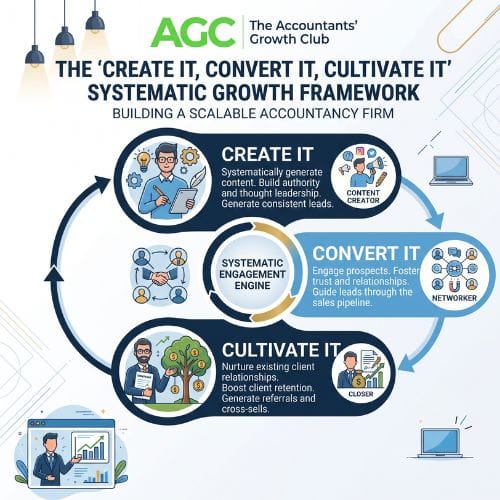 Here’s what we tell them: you cannot expect a new team member to immediately possess your level of gravitas or closing ability. I know, it’s a shame, but that’s just unrealistic.
Instead, the most effective way to get your accounting team to do business development is to break the process down into three stages: Create It, Convert It, Cultivate It. When you do this, you can build your business development team within your accounting firm without hiring a business development or sales specialist.
This stage covers everything your practice does to generate a fresh client enquiry. Your team can contribute here without the pressure of “selling.”
The Content Creator: Instead of forcing staff to “sell,” assign them to write technical updates or blog posts based on real questions they hear from clients. This gets them to use their technical expertise to help your accounting firm’s marketing without the pressure of feeling they need to be involved in sales. If they tell you “I’m not good with words that’s why I went into accountancy” then help them use AI to create a credible first draft for them (and you) to polish and make it sound like the firm rather than ChatGPT or Claude.
The Networker (Junior Level): Allow junior staff to develop relationship management skills by acting as the “Relationship Lead” for your B-Lister or C-Lister contacts. They can manage follow-ups, send birthday cards, and maintain the relationship without needing to close deals.
Support Tasks: You can delegate or outsource the routine “admin” of networking, such as:
 Case study: How Sian built a £1m practice without doing her own marketing
Sian Kelly, Founder of Inform Accounting, wanted to build a one million pound practice that could be run during school hours. She was already at capacity and couldn’t add “content creator” to her job description. So she didn’t.
Instead, she invested heavily in organic SEO and social media, but outsourced every bit of it. Her outsourced Marketing Director produces the firm’s content. Her sister manages Facebook, Twitter and LinkedIn for 2-3 days a week, making sure engaging content is regularly shared across all channels.
Inform Accounting is now an award-winning practice over £1.5m. Sian broke through the £500k ceiling by accepting she didn’t have to be the one doing the marketing, she just had to make sure it got done.
This stage covers every step involved in turning leads into clients: qualifying enquiries, meetings, quoting, and onboarding.
The Hand-off: Think of it like a football team: your team’s “midfielders” prepare the ground and pass the ball so that you, the “striker,” can land the plane and close the deal.
The Closer: High-stakes negotiation and final conversion meetings should remain with you or senior leadership until the team is fully trained.
Standardisation: To delegate this effectively, you must document your “Convert It” process so the team has a standard script and protocol to follow.
a
To break the “feast or famine” cycle and maximise your practice’s capital value, you must implement a system where the firm can grow without your constant presence. If you remain the only one who can win a new client or piece of work you become a bottleneck, and you and your accounting firm are the ones who suffer. Mastering the art of “how to get my team to do business development” starts with pushing work down to free up your time for high-level strategy, so now that you have your BD team in mind, it’s time to delegate.
Here is the delegation framework that we teach our Accountants’ Growth Club members to follow:
You cannot scale while “working in” the business; something must come off your To-Do list.
For example:
 Case study: How Paul doubled his leads for £120 a month
Paul Miller, Founder of Cornish Accounting Solutions, loved going out and hustling for clients at Cornish Accounting. After attending a workshop on social media marketing, he was sold on the idea, but he was working flat out and didn’t have the time or inclination to actually do it himself.
For £120 a month, he outsourced writing blog posts and managing Twitter and Facebook updates. His social media expert writes a blog post a week and distributes it via the firm’s channels. Paul just shares articles he knows their Client Personas would value.
They trialled it for three months, and the number of leads they generated doubled. Long story short, they’ve been doing it ever since.
You cannot delegate what is only in your head. This will only lead to disappointment when the team doesn’t mirror your results. Instead, we recommend using a “Stick List” – a visible tracker for every prospect or lead.
Implement Weekly Rhythm Meetings to review the “Stick List” (live leads). If you don’t inspect it, they won’t respect it. This keeps everyone accountable and ensures that things are moving forward.
a
Business development is not an “extra” task; it must be viewed as part of the day job for every staff member, from the receptionist to the senior accountant. Every interaction, from a friendly greeting to an accurate tax return, is a step in the client journey that encourages a referral. So you need to help your team understand the importance of this and their role in it.
If you want to go beyond how to get my team to do business development to how to get them to do it consistently (and without you nagging), here are 4 ways to make it a part of your culture:

Set the expectations early that everyone is involved in business development. Too often we bring them in and don’t talk about this, then wonder why they’re not interested.
The more your staff understand the connection between their day job and how this helps your firm keep, grow or win more work, the more they’ll want to take part in business development. So involve them in the conversations, the planning, and the results as much as possible.
Don’t simply hope staff will get involved; tell them exactly what you want them to do and then give them the training and support they need to start doing it naturally.
These new skills should form part of the Work and Development Plan, which you discuss regularly.
 Written by Becky Rogers. Becky has spent the last 10+ years writing copy and content for Accounting firm owners and Accounting specialists. Over the last 5 years she’s written copy for over 30 accountants’ websites. Connect with Becky on LinkedIn.